What Is Schema Markup? Structured Data Guide for AI Search Engines
21 MAY 2026
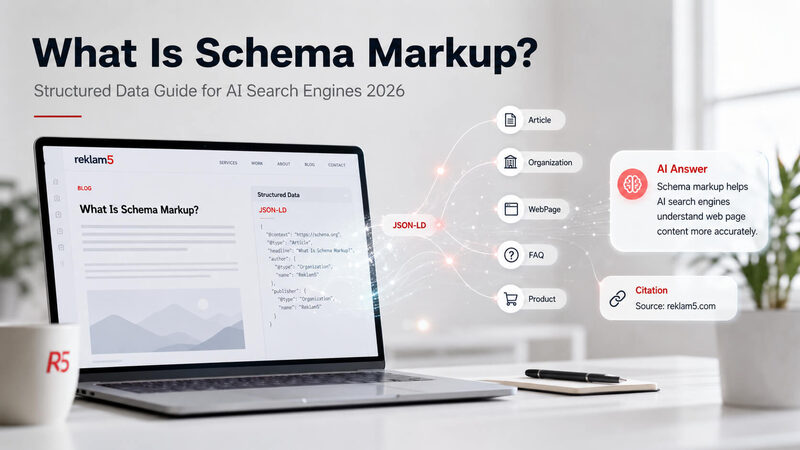
Schema markup (structured data) is a universal coding language that enables search engine bots to not just crawl, but deeply understand the context of your website's content. By 2026, alongside traditional Googlebot web crawlers, AI-native search engines like ChatGPT, Perplexity, and Google AI Overviews prioritize structured data when parsing digital properties. Implementing the correct schemas within your codebase serves as a direct communication channel, allowing artificial intelligence to recognize your site as a trusted entity and a verified source of answers, preserving your brand visibility in a zero-click world.
Differences Between Schema for AI Search and Standard SEO
Bot Processing Velocity vs. Plain Text Scraping
-
In standard SEO, Googlebot processes raw HTML and plain text to map your site's architecture over time.
-
AI search engines focus heavily on structured data to instantly decipher entity relationships and contextual meaning.
-
Schema codes allow large language models (LLMs) to map your content elements in seconds, paving the way for your site to be selected as a cited source in AI summaries.
From Rich Snippets to Generative AI Citations
-
Historically, structured data was primarily utilized to secure Google rich snippets, such as star ratings, review badges, or drop-down accordions.
-
In 2026, structured data has transitioned into the core of AI-driven technical SEO, serving as the primary pipeline for feeding clean, verified, and error-free data directly into LLM knowledge graphs.
Core Structured Data Types for Getting Cited in AI Search
FAQPage Schema
-
This remains one of the most critical schema types used by AI engines to extract direct, high-confidence answers for conversational user queries.
-
Marking up your Q&A content blocks with this schema significantly boosts the probability of conversational AI assistants selecting and citing your content.
Article and TechArticle Schema
-
Explicitly clarifies the author, publication date, and core thesis of a piece of content, sending an unmanipulated trust signal directly to Google's E-E-A-T evaluation systems.
Product and Organization Schemas
-
Crucial for enterprise e-commerce platforms and global brands to feed AI engines with structured product prices, stock availability, and official brand attributes, ensuring recommendations in transactional AI searches.
How to Implement Schema Markup
JSON-LD Technology as the Technical Standard
-
What is JSON-LD: It is a JavaScript-based structured data format injected as a clean block into the <head> or <body> of a page, highly recommended by Google and modern AI bots for its ease of reading.
-
Because it encapsulates data without breaking or altering on-page HTML elements, it drastically reduces the margin of error during technical SEO deployments.
FAQPage Schema Text Structure and Logic
The linguistic foundation of an FAQ schema processed by AI engines relies on two primary text elements: Question and acceptedAnswer. When structuring this data block, the exact query visible to human users on the webpage is assigned to the "name" field, while the direct, unmanipulated response is mapped to the "text" field as plain text. AI bots scan this hierarchical text pairing to seamlessly integrate the facts into their real-time answer generation systems.
Most Common Technical Mistakes in Structured Data Management
Invalid Syntax and Broken JSON-LD Structure
-
Trailing commas, missing quotes, or unclosed brackets render the entire code block invalid, causing search bots to skip the data entirely.
-
Always validate your scripts using the official Google Rich Results Test before pushing code deployments to your production environment.
Mismatched Schema Content (Crawl Budget Waste)
-
Injecting hidden FAQ questions or manufactured product fields into your schema data that do not physically exist on the visible webpage is flagged as structured data manipulation.
-
This practice can trigger Google manual actions and causes search engine crawlers to waste valuable crawl budget on low-value or contradictory data.
Measuring Schema Markup Success
GSC Rich Result Monitoring and GA4 Analysis
-
Track your indexation health via the specific enhancement tabs (e.g., "Merchant Listings", "FAQs", or "Review Snippets") inside Google Search Console to catch validation warnings early.
-
Use GA4's event-based tracking architecture to isolate traffic arriving via rich results or AI citations, analyzing their engagement rate and subsequent conversion funnel performance.
Do you want to integrate schema markup into your site and appear as a cited source in AI search engines? Step ahead of the competition with the Reklam5 technical SEO team.
Copyright 2026 - Reklam5: Dijital Ajans · Powered by 