How to Determine Your Google Ads Budget? 2026 Industry Guide
15 OCTOBER 2026
The Core Logic and Formulas for Google Ads Budgeting
Balancing Cost Per Click (CPC) and Conversion Rate
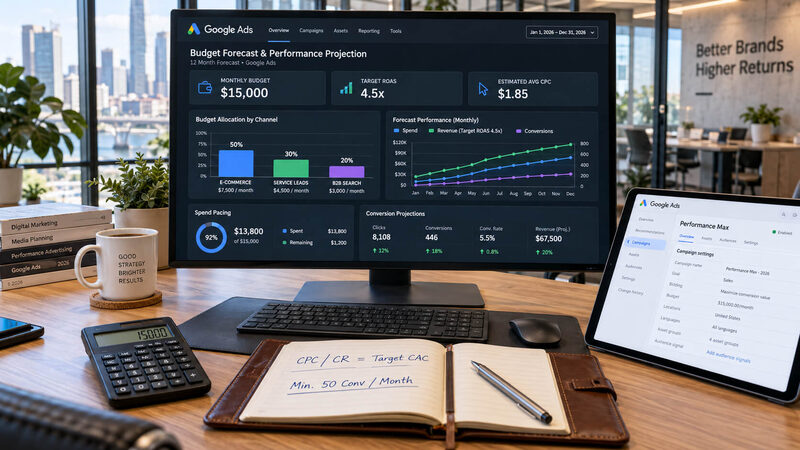
When structuring a monthly Google Ads budget, your primary benchmarks should be your industry's benchmark CPC and your website's historical conversion rate (CR).
For instance, if your average CPC is $2.00 and your site converts at 2%, generating a single sale or qualified lead requires an average of 50 clicks—equating to a target acquisition cost of $100.
Statistical Significance and the Algorithmic Learning Phase
Google Ads Smart Bidding algorithms require a consistent baseline of at least 30 to 50 conversions per month per campaign to optimize effectively.
Setting a daily budget below this data threshold prevents machine learning models from exiting the learning phase, leading to volatile bid swings and wasted ad spend.
Google Ads Budget Strategies by Industry
1. E-Commerce: ROAS and Average Order Value (AOV) Modeling
For online retailers, budget planning hinges on Average Order Value (AOV) and target ROAS goals.
To effectively fuel Google Shopping and Performance Max campaigns across wide product catalogs, allocate sufficient daily budget to generate at least 30–50 clicks per day during launch phases.
2. Service Sector: Lead Quality and Sales Closing Rates
In professional verticals like medical clinics, legal services, contracting, and consulting, overall search volume is lower while CPCs run significantly higher.
Budgets must be reverse-engineered by determining how many inquiries convert into paying clients, establishing your true Customer Acquisition Cost (CAC) ceiling.
3. B2B and Enterprise: High Contract Value and Extended Sales Cycles
In B2B sectors, a single closed deal can represent tens or hundreds of thousands of dollars in lifetime revenue.
Premium CPC rates are routine in this category; allocate ad spend strictly to high-intent Search keywords and structured first-party remarketing audiences.
4 Critical Steps to Optimize Google Ads Costs
Improving Quality Score
Success in the ad auction goes beyond high bidding; refining keyword relevance, expected CTR, and landing page user experience can lower your actual CPC by up to 50%.
Proactive Negative Keyword Management
Continuously audit search query reports and update shared negative keyword lists to prevent irrelevant queries from draining your daily spend.
Strategic Geo-Targeting and Ad Scheduling
When working with finite budgets, exclude low-converting geographic zones and concentrate on daily delivery during peak purchasing hours.
GA4 Integration and First-Party Value Signals
Feed GA4 conversion values and offline purchase milestones directly into your ad accounts to guide smart bidding towards your highest-margin customer segments.
To calculate the most profitable Google Ads budget tailored to your industry and maximize your campaign return, contact the Reklam5 team today. Partner with our specialists to engineer a scalable media-spend model for your business.
Copyright 2026 - Reklam5: Dijital Ajans · Powered by 