E-Commerce, Service, or Local Business: Google Ads or Meta Ads for Your Industry?
JULY 31 ,2026
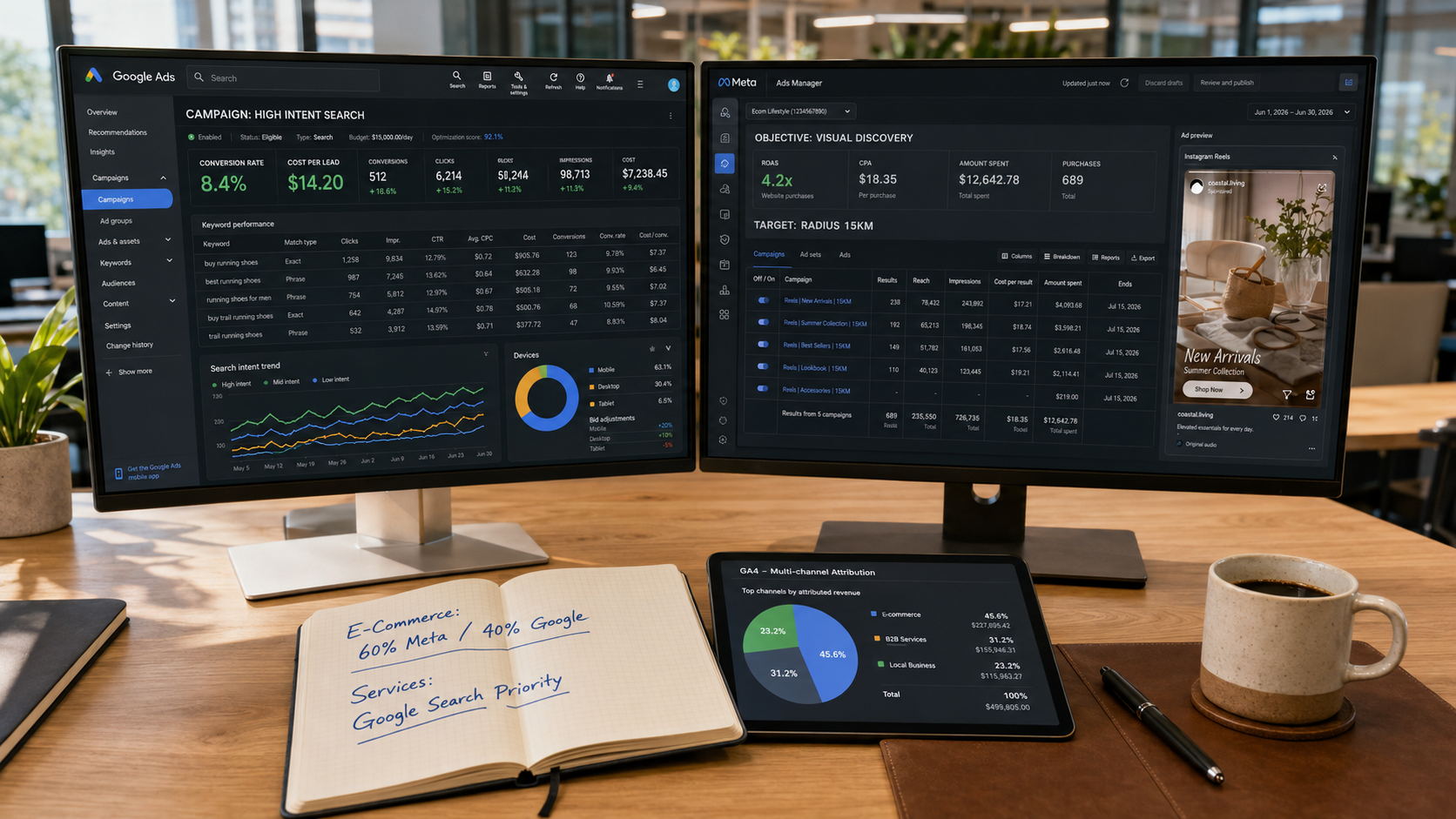
One of the most frequent questions businesses ask when allocating digital marketing budgets is "Google Ads or Meta Ads?" However, there is no single, one-size-fits-all answer to this question. The real question you need to ask is: "Which platform is more profitable for my specific industry and business model?" In the 2026 advertising ecosystem, Google Ads focuses on high purchasing intent, whereas Meta Ads (Instagram & Facebook) relies on interest-based visual discovery. In this guide, we compare both platforms through concrete data across e-commerce, service sectors, and local businesses.
Intent to Purchase vs. Visual Discovery: Core Differences
Search Intent and Google Ads Tactics Google Ads targets users at the exact moment they are actively searching for a specific product or service. When users enter explicit queries like "emergency locksmith," "2026 running shoes prices," or "SEO agency," Google Search delivers the highest conversion rates because the customer is aware of their problem and ready to buy.
Interest-Based Targeting and Meta Ads Visual Power Meta Ads engages users based on their interest profiles, lifestyle behaviors, and demographics before an immediate need is explicitly expressed. By generating demand through engaging image and video formats (Reels) across Instagram and Facebook feeds, Meta captures attention and drives conversions through a visual discovery experience.
Digital Ad Channel Selection by Industry
E-Commerce: Google Ads vs. Meta Ads?
For e-commerce brands, determining which platform should receive the majority of ad spend depends heavily on product catalog characteristics. For items with high search volume and specific utility, Google Shopping and Performance Max campaigns excel; conversely, for visually appealing products such as fashion, home decor, or jewelry, Meta Ads significantly lowers cost-per-acquisition (CPA). The most profitable approach often relies on a balanced allocation—such as a 60% Meta and 40% Google Ads split.
Service Sector: High-Converting lead generation for service-oriented businesses including B2B firms, consulting agencies, health tourism, and educational institutions Google Search Ads remains the undisputed leader. Because prospective clients searching for professional services are actively seeking immediate solutions, lead quality and closing rates driven by Google Ads are significantly higher than those generated via social feeds.
Local Businesses: Maps and hyper-local radius targeting for brick-and-mortar setups like restaurants, clinics, beauty salons, and auto repair shops, an optimal local ad strategy combines the spatial capabilities of both platforms. Google Maps (Local Search) ads capture high-intent nearby customers in real time, while Meta Ads' radius-based location targeting builds neighborhood brand awareness and foot traffic.
2026 Ad Budget Optimization Strategies
Attribution and Multi-Channel Funnel Analysis In 2026, the customer journey is rarely confined to a single touchpoint. A customer might discover a product on Instagram, research it on Google, and convert days later. Using data-driven attribution models within Google Analytics 4 (GA4) allows you to evaluate the precise multi-touch contribution of both channels to your overall ROI.
If you want to direct your advertising budget to the right platform, contact the Reklam5 team today. Meet with our experts to design a tailored, high-performing digital advertising strategy for your industry.
Categories
Copyright 2026 -
Reklam5: Dijital Ajans