How to Protect Your Click-Through Rates in the Google AI Overviews Era
3 JULY 2026
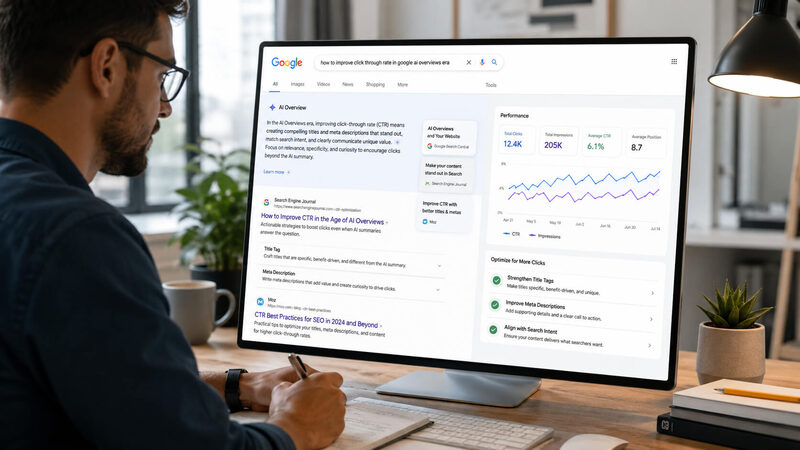
Google’s AI-driven search experience (AI Overviews) resolves informational user queries directly on the search engine results page, causing a significant decline in traditional organic click-through rates. By 2026, as standard blue links lose their primary visibility, pulling users to your website from below the AI summary box requires an entirely new framework. In this guide, we will analyze 6 concrete tactics for title tag and meta description optimization to safeguard your CTR and turn the organic traffic drop into a high-quality lead generation channel.
CTR Dynamics and Evolving User Behavior in the AI Era
Rapid Consumption vs. Curious Engagement
-
In traditional search setups, users clicked the top results to dig for answers inside the webpage; in the AI Overviews era, they consume answers within seconds right on the Google interface.
-
While this mechanism accelerates the "zero-click" phenomenon, brands that engineer title tags to trigger curiosity and offer deep-dive analysis continue to acquire premium traffic.
The Value and Positioning of Citation Links
-
Google AI Overviews display the websites they extracted information from as interactive citation cards right alongside or underneath the generated response.
-
The editorial quality of the title and meta description displayed within these citation cards acts as the ultimate deciding factor for users to click through and "read the full expert report."
6 Concrete Tactics to Protect Your Click-Through Rate
1. The "Unrevealed Detail" Strategy for Title Tags
-
Avoid giving away your entire thesis within the title tag; instead, signal that a much deeper analysis, real vaka study, or actionable template is available inside the page.
-
Aligning with 2026 search trends, replace generic titles like "What is X?" with high-intent variations such as "X Guide: 5 Critical Details Hidden from AI Overviews."
2. Crafting Metas that Complement AI Summaries
-
Position your meta descriptions as a supportive "trust statement" built on real-world experience and real-time data that fills the gaps of the automated AI text.
-
Explicitly indicate within a clean 120-130 character limit that your page offers specialized data far beyond the surface-level definitions provided by standard LLMs.
3. Emphasizing E-E-A-T and First-Hand Experience
-
While generative AI excels at parsing data grids to deliver broad truths, it cannot simulate authentic human experience (Experience).
-
Highlight phrases that project authority and trust within your meta tags, such as "Backed by 17 Years of Industry Expertise," "Engineered from Field Data," or "Real Case Studies Included."
4. High-Density Q&A Structures
-
Structure your structural text and meta values into crisp, sharp, and highly concise answer units that search models can easily reference.
-
Supplementing these zones with advanced schema markup prompts Google to select your asset as the prominent primary citation card inside the main summary block.
5. Next-Generation Implementation of Call-to-Actions (CTA)
-
Retrench outdated phrases like "Click here to read more" and replace them with the concrete, tangible value proposition that the user will obtain upon entry.
-
Utilize actionable verbs such as "Access the Free Calculator," "Download the 2026 Interactive PDF," or "Explore the Live Data Feed" to systematically boost CTR performance.
6. Continuous CTR Auditing via GA4 and Search Console
-
Routinely map your Google Search Console performance alongside GA4 to filter and detect high-impression pages suffering from sudden click-through degradation.
-
Revise and optimize the meta elements of these pages using more aggressive, curiosity-driven, and highly original angles tailored to AI search behaviors.
Common Meta Data Mistakes in AI Search Configurations
Mirroring the Exact Language of AI Outputs
-
Replicating the exact definitions that generative algorithms already display by default inside your content and meta tags eliminates any reason for users to click your link.
-
To win organic clicks, your digital assets must present an alternative, sophisticated perspective that picks up exactly where the AI Overview card leaves off.
Over-Extended Meta Titles and Descriptions
-
Content snippets that exceed the maximum pixel constraints get truncated within citation cards, creating a broken and unprofessional brand presentation.
-
To avoid "Title/Description Too Long" flags in site auditors like Semrush and ensure seamless rendering across mobile screens, maintain rigid adherence to ideal character lengths.
Do you want to protect your organic click-through rates and stand out as an industry authority in the generative AI era? Future-proof your digital real estate today with the Reklam5 SEO and content optimization team.
Copyright 2026 - Reklam5: Dijital Ajans · Powered by 