White Label Reputation Management Software: Top 10 Picks
23 NOVEMBER 2026
If your biggest client signed into your reputation platform tomorrow, would anything on the screen, in the page source, or on the invoice tell them it isn't yours?
Most platforms pass the logo test and fail everything after it. The login sits on the vendor's domain. Widget embed code carries the vendor's script. The monthly report arrives from a sender address you can't change. Meanwhile the pricing model determines whether that client is profitable, and per-location fees turn a 40-location retail account into a margin problem at renewal.
So this list doesn't rank feature grids. Every platform below is judged on the three things a client notices before they look at a single chart:
- White-label depth. What's rebranded (domain, sender email, widget script, help center, billing) versus what's a logo swap or a paid add-on.
- Pricing fit for a portfolio. Flat-rate, per-location, per-seat, or marketplace wholesale, and what happens to your margin when a client doubles their locations.
- Rollout friction. How long before a client can log in, and what you have to build outside the platform to make the experience feel finished.
Table of Contents
- 1. EmbedMyReviews
- 2. Synup
- 3. Reviewshake
- 4. Grade.us
- 5. Vendasta
- 6. EmbedMyReviews
- 7. LocalClarity
- 8. BrightLocal
- 9. ReviewInc
- 10. ReviewTrackers
- 11. HighLevel
- White label reputation management platforms compared
- How to Choose and Roll Out Your Platform
1. EmbedMyReviews
The dashboard below is what a client sees when the vendor has committed to disappearing from the interface entirely.
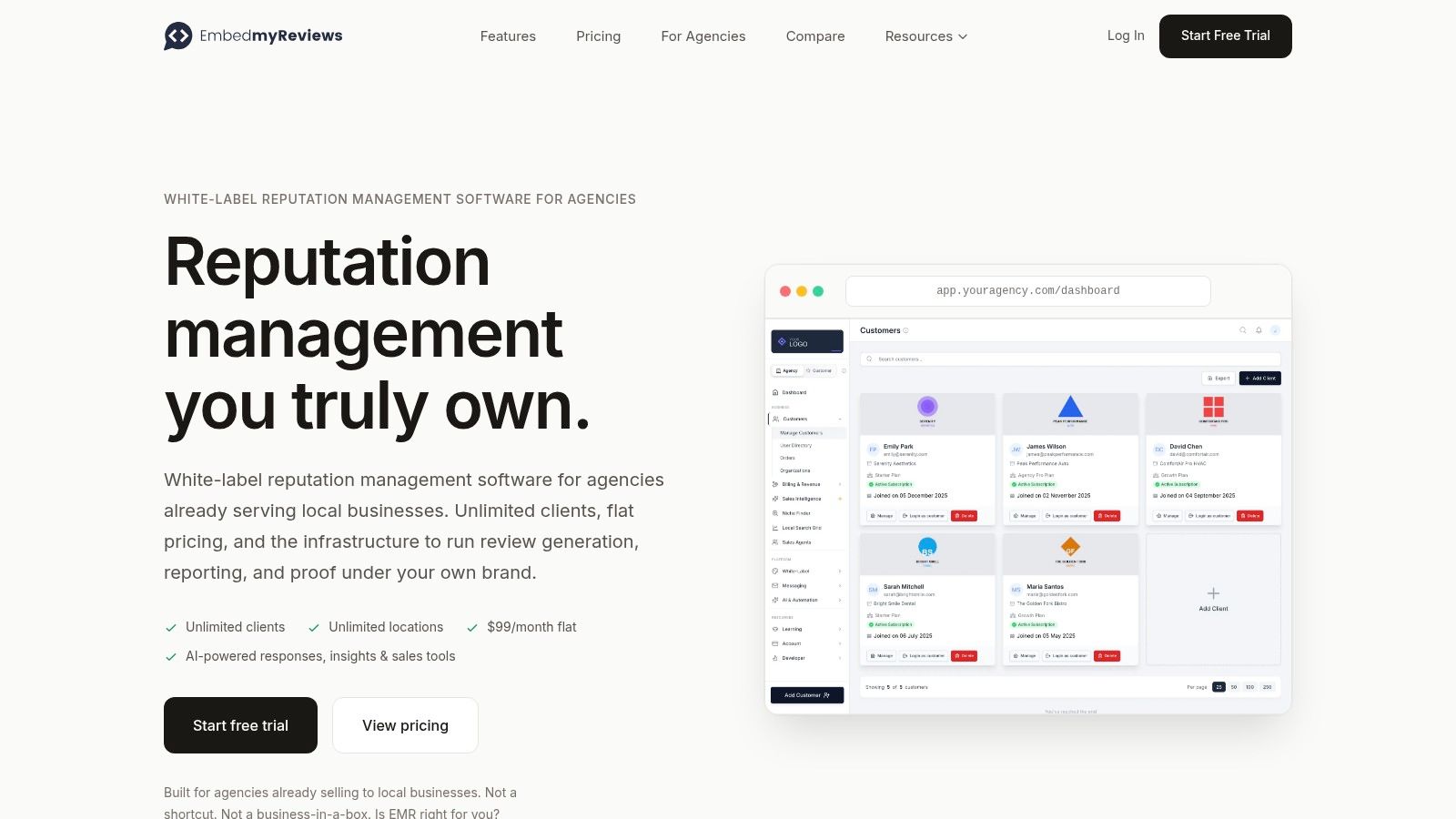
EmbedMyReviews is built around agency ownership rather than agency access. The platform runs on your domain with your SSL, your branding, your help center, your API docs and your page builder, in 27 interface languages. The test isn't the logo. It's whether a client can find the vendor anywhere in the product, including the source code behind a review widget.
The commercial model is the differentiator. A flat $99/month covers unlimited clients, locations and users, with no per-location or per-seat pricing in the base platform. An agency running 60 locations pays what an agency running three pays. That single decision changes which clients you can profitably take on.
What actually ships inside the platform
- Review operations: management across 67+ sources, request campaigns through bring-your-own-key email, SMS and WhatsApp, multi-step feedback funnels with private routing, QR and NFC tracking.
- AI responses on your keys: OpenAI or OpenRouter credentials you supply, global prompt templates, tone matching, and human approval before anything publishes.
- Google Business Profile posting: updates, offers and events with client email approval that doesn't require a login, plus location geotags and media handling.
- Local Search Grid: geo-distributed rank tracking with recurring scans and white-label PDF exports.
- Sales intelligence: AI audit reports, a Trust Score, competitor benchmarks and LLM visibility testing.
- Agency plumbing: Stripe billing with custom client plans and credit limits, sales agents with territories and commissions, Zapier, HubSpot, HighLevel, Shopify and WooCommerce integrations, REST API and webhooks.
The trade-offs nobody puts on a pricing page
Bring-your-own-key cuts both ways. You keep wholesale rates and regional provider choice, and you also own deliverability problems, key rotation and every carrier hiccup. The scope is large, spanning audit reports, GBP publishing, rank grids and billing, so somebody on your team has to own configuration.
Practical rule: Open your live client portal, view the page source, and search for the vendor's name. If it appears in a widget embed or a script tag, the rebrand is cosmetic.
For agencies that want the client relationship, the billing and the interface to sit under one roof, it's the most complete answer on this list. You can review the white label reputation management software for resellers in more detail before a trial.
2. Synup
Synup prices like a listings company, and that shapes how you resell it. White labeling sits on Premium and above, so buying the entry tier as a cheap test gets you a product you can't put your name on. Premium starts at $239/month for up to 10 locations, with a 14-day trial and one test location.
The rebrand itself is properly engineered. You set the portal domain with Synup's CNAME and TXT records, the sender handle on that domain, the app name, favicon and colors, the AI assistant's name, menu order, and even a custom tracking script. It's a one-time setup, not a per-client rebuild.
- Where it earns its fee: review monitoring, invitations by email and SMS, an inbox that consolidates every source, AI drafts you approve rather than auto-publish, and competitor review velocity tracking.
- Where the model strains: location limits push costs up as a portfolio grows, and the entry price is steep for a two-client pilot.
- What it isn't: enterprise-wide brand listening. It's built for local and multi-location businesses.
Synup's unified inbox makes more sense once you look at how buyers behave. BrightLocal's 2025 survey of 1,026 U.S. adults, summarized in Farabiulder's social proof statistics roundup, found that 85% use Google to find reviews and 74% check at least two review sites before deciding. Google-first is correct, but a dashboard showing only aggregate stars will miss channel-specific trust problems. See Synup's white label reputation management platform for the current tier breakdown.
3. Reviewshake
Reviewshake does the thing most vendors in this category avoid: it publishes an agency price. $199/month covers 10 clients, 25 locations and 15 users, month to month, no setup fee, with a 14-day trial. For an agency launching a reputation line without a sales call, that transparency saves real time.
The white label reaches further than most at this price. Your domain, logo, sender email addresses, dashboards and scheduled reports are all branded, monitoring runs across more than 100 sites, and review requests go out by email and SMS with reminders and website widgets attached.
Two limits matter in practice. SMS coverage is restricted to the US and selected other countries, which kills the channel for some markets. Direct replies to reviews aren't equally available across all supported sites, so the inbox can show a review you can't answer from the dashboard.
A reply only counts as a deliverable on sources that support API responses. Check that list against your clients' industries before you sell response management as a service.
Volume targets deserve the same scrutiny. Figures reported from BrightLocal's Local Consumer Review Survey put 59% of consumers saying a business needs between 20 and 99 reviews before they trust its average star rating, per Shno's review and ratings statistics. That's the number behind every request campaign you'll build, and it's why the request tooling matters more than the reporting layer. Start with Reviewshake's white label platform.
4. Grade.us
Grade.us sells the rebrand as a line item, and you should price it the same way. Small Business runs $99/month for one location, agency plans start around $400+/month for 10 or more seats, and the White Label Premium add-on is listed at $440/year, subject to plan availability.
Where the add-on model bites
The review funnel is the product here: monitoring across Google, Facebook and more than 100 sites, automated request campaigns, custom funnel URLs, branded reports and email notifications. Premium dashboard branding and API access land on eligible plans only.
The friction is arithmetic and clarity. If you're reselling to 12 clients, the seat count plus an annual branding add-on needs modeling before you quote a retainer. Plan details are hard to compare side by side, and per-client configuration takes real hours.
Responses are where the money is. Search Engine Land's online review stats guide reports that roughly 88% of consumers expect businesses to respond to reviews, while 48% distrust reviews that appear AI-written. That combination rules out set-and-forget automation and argues for approval queues with named owners. Grade.us can run that workflow, but you have to design it. A 14-day, no-credit-card trial makes testing cheap, so check Grade.us plans against your real client count first.
5. Vendasta
Vendasta answers a different question. Not which reputation tool to white label, but how to resell an entire catalogue of services without building the back office yourself.
Reputation AI handles the mechanics: review requests triggered around completed jobs or appointments, AI-drafted replies with configurable approval before publishing, and white-label client-facing apps with adjustable product branding. The marketplace and optional fulfillment services sit around it, so an agency can sell local SEO, listings and advertising from the same branded storefront.
- What works: combining reputation with services you already resell, and using fulfillment to take on delivery before you hire.
- What doesn't: product selection. The ecosystem is wide enough that agencies spend weeks deciding what to bundle instead of selling.
- The cost structure: platform access is listed as free with trials on some products, but Reputation AI pricing depends on eligible plans and partner configuration, and total spend includes wholesale product prices on top.
AI responses need a policy, not just a toggle. GatherUp's Beyond the Stars 2025 report found that 70% of respondents trusted a business less on discovering its review responses were AI-generated. The same research covers a 2025 blind comparison where consumers preferred an AI-generated business response 58% to 42%, which tells you supervised drafting is fine and undisclosed automation isn't. Clients judge resellers as vendors too, so the criteria for choosing a digital agency apply in reverse. See Vendasta's reputation management module for plan eligibility.
6. EmbedMyReviews
The platform appears twice in this list, and the second slot is about pricing structure rather than delivery. A flat $99/month for unlimited clients and locations means unit economics improve with every multi-location account you sign, which per-location pricing cannot offer once a portfolio grows.
The client-facing layer covers the essentials well. Custom domain, logo and colors carry through the portal, while review collection, aggregation, widgets and campaigns run underneath. External email provider connections keep sending on agency-branded addresses, and client subscription plus Stripe billing let you invoice under your own name instead of forwarding a vendor receipt.
Run the trial against three checks:
- Portal depth: log in as a test client and confirm every screen carries your domain and branding.
- Sender domain: verify review requests send through your configured email provider. Third-party messaging, email and billing services bill separately, so budget those as pass-through costs on top of the subscription.
- Billing flow: run a test subscription through Stripe and check what the client's statement and receipts show.
Teams that only want monitoring and reporting should skip it. The wider agency platform adds configuration they will never bill for. The vendor sells this directly as white label reputation management software, so evaluate the reseller workflow first.
7. LocalClarity
LocalClarity makes agencies earn the full rebrand, and that gating is the first thing to understand. Professional is $20 per location monthly, or $16 per location monthly billed annually. Custom-domain white labeling is reserved for agency partners managing 20 or more client locations, with agency and enterprise pricing quoted privately.
Below that threshold you still get branded client reporting, multiple client profiles under one account, review coverage across more than 50 sources, and listings and local search functions alongside the reputation workflow. Multilingual interface and response support helps if you run clients across borders.
The 20-location threshold
Fourteen locations means branded reports without a custom domain. If the domain matters to your positioning, either consolidate more accounts or wait. Above 20 locations the per-location rate becomes the main cost question, and it scales linearly with the portfolio, which is fine for large multi-location clients and painful for a group of small single-site businesses.
The demand side justifies the local focus. BrightLocal's 2024 Local Consumer Review Survey, a representative survey of 1,141 consumers, found that 75% of U.S. consumers always or regularly read online reviews when evaluating local businesses. Review-only teams may find the local-search layer unnecessary, so check LocalClarity against what you bill for.
8. BrightLocal
BrightLocal is the vendor whose statistics your clients have already heard quoted at them, which is an unusual kind of brand recognition to resell.
The Grow plan includes review monitoring, generation, responses and widgets from $65/month for one location billed monthly, or $49/month billed annually, with a 14-day trial. Around it sit rank tracking, citations and local audits, all exportable under agency branding.
- Strong fit: agencies already selling local SEO retainers who want review progress reported next to visibility movement.
- Weak fit: agencies that need a fully rebranded client portal. Tools and reports carry your brand; a custom-domain destination doesn't.
- Pricing behavior: costs scale with active locations and plan level, so a portfolio of small single-location clients gets expensive faster than one large account.
The credibility argument is now the selling point. BrightLocal's 2025 survey found that 42% of consumers trusted online reviews as much as personal recommendations in 2025, down from 79% in 2020, per the 2025 Local Consumer Review Survey. Review volume stopped being a proxy for trust five years ago, which is why reporting on recency, response quality and source mix beats reporting on star average. If local visibility is the wider mandate, read up on what local SEO involves before you scope. Start with BrightLocal.
9. ReviewInc
ReviewInc runs a true reseller model. Agencies set client pricing, bill clients directly, and the provider states it holds no direct relationship with those end customers. For agencies that treat reputation as their own product rather than a referral fee, that structure is the whole point.
The branded layer covers dashboards, reports, notifications and customizable skins, with an admin portal for account setup, templates, reporting and access controls. Listings, local SEO and social tools sit alongside review monitoring and response management. API, SSO and custom-domain options exist, and some carry extra fees.
Pricing starts under $100 per location monthly according to the vendor, with volume discounts and exact rates quoted by sales. Partner onboarding, training and sales materials shorten the ramp for a team new to the category.
Rule of thumb: When you bill the client directly under your own name, compliance exposure becomes yours. Build review-acquisition policy into the contract, not the onboarding call.
That matters more every year. Rank's online review statistics reports that Google blocked or removed more than 292 million policy-violating reviews in 2025, up from 240 million in 2024, while the FTC's U.S. Consumer Review Rule bans fake or AI-generated reviews, buying reviews for a particular sentiment, undisclosed insider reviews and review suppression, with civil penalties reported up to $53,088 per violation. Ask about compliance evidence and dismissal rates. See ReviewInc's white label program.
10. ReviewTrackers
ReviewTrackers is the platform here most likely to be sold to a client as insight rather than software, and that positioning suits agencies whose retainers include analysis.
Monitoring and aggregation run across more than 100 sources. The multi-tenant account structure keeps clients separate, while reputation scorecards and risk-management dashboards surface the patterns a client would never spot in individual reviews. Partner scorecards, API access and custom partner billing round it out.
- The honest trade-off: white labeling is an add-on rather than part of the base plan, so model it before you promise a branded experience.
- The pricing reality: rates are custom and location-based, available only through a sales conversation. No public number, no calculator.
- The fit question: analytics-heavy workflows are overkill for clients who want review requests and replies handled. Sell it to clients who buy reporting.
For agencies in that position, the analysis is the deliverable and the branding is the wrapper. For everyone else it's a heavier tool at a heavier price. Review the ReviewTrackers agency partner program to see where white labeling lands in the tiers.
11. HighLevel
HighLevel approaches reputation from the opposite direction. Reputation tools sit inside an agency CRM, connected to contacts, pipelines and revenue data, rather than the CRM sitting next to a reputation tool.
Public pricing lists Starter at $97/month, Unlimited at $297/month, and Agency Pro at $497/month, with a 14-day trial and usage charges on some services. Agency Pro includes SaaS Mode and rebilling, which is what lets an agency sell a branded software experience rather than a service.
When SaaS Mode actually pays
If you already run client pipelines, funnels and messaging through HighLevel, adding reviews means one login for the client instead of three, and review activity ties directly to a contact record. That's a genuine operational win.
If reputation management is the only product you'd use it for, the math inverts. You're paying for CRM, automation, funnels and messaging to get a review module, and Agency Pro is a substantial commitment for that. Usage-based messaging adds cost unpredictably.
The consolidation argument gets stronger for agencies already coordinating social and review workflows in one place. Services that manage the same client channels live in the same operational stack, and teams blending them often evaluate social media management tools alongside reputation platforms. Start with HighLevel's reputation management software.
White label reputation management platforms compared
The table below pulls together starting price, white-label depth, trial availability and the agency profile each platform fits. Read the White-Label Depth column as what carries your branding, not what the vendor's feature page calls white label.
| Platform | Starting Price | White-Label Depth | Trial | Best For |
|---|---|---|---|---|
| EmbedMyReviews | $99/month | Custom domain, branded portal, and client billing | No public trial listed | Agencies managing many clients or locations at a flat rate |
| Synup | $239/month for up to 10 locations | Branded workspace with custom logo, colors, and domain | 14 days | Agencies combining review management with listings and local SEO |
| Reviewshake | $199/month for 10 clients, 25 locations, and 15 users | Branded domain, email, dashboards, and reports | 14 days | Agencies needing review monitoring and automated requests |
| Grade.us | Agency plans from $400+/month; small-business plan $99/month | Branded reports and funnels; enhanced dashboard branding on select plans | 14 days | Agencies focused on review funnels and branded reporting |
| Vendasta | Plan-based; priced per product and market | White-label client apps and configurable branding | Trial on select products | Agencies reselling multiple services with optional fulfillment |
| LocalClarity | $16/location/month billed annually; $20 monthly | Custom-domain white label for agencies with 20+ client locations | No public trial listed | Multi-location teams needing reviews and local-presence tools |
| BrightLocal | $49/month annually or $65 monthly for one location | Branded tools and reports; no custom-domain client portal | 14 days | Agencies pairing reputation services with local SEO |
| ReviewInc | Under $100/location/month | Branded dashboards, reports, and notifications; some options may cost extra | No public trial listed | Agencies seeking a reseller model with flexible client pricing |
| ReviewTrackers | Custom, location-based pricing | Optional white labeling | No public trial listed | Agencies selling reputation analysis and customer insights |
| HighLevel | $97/month | Branded software experience with SaaS Mode on Agency Pro | 14 days | Agencies combining reputation workflows with CRM and automation |
Two columns deserve a closer read than the rest. White-Label Depth separates the platforms where clients log in on your domain, such as EmbedMyReviews, Synup and Reviewshake, from those that brand reports and dashboards but keep the vendor's infrastructure visible, such as BrightLocal and ReviewTrackers. The gap only shows up when a client types in a URL.
Starting price matters less than the pricing model behind it. EmbedMyReviews and HighLevel charge a flat monthly figure regardless of client count, while LocalClarity, BrightLocal, ReviewInc and ReviewTrackers scale per location, so the cheapest row at five locations stops being cheapest at fifty.
How to Choose and Roll Out Your Platform
Which platform survives contact with your actual book of business? Start from how you sell. If reputation is a managed service, you need ownership of the interface, sender domain, report and invoice; that favors specialist tools where the rebrand is native. If reputation is one line inside listings, local SEO and CRM work, an all-in-one can be the better buy even when the logo sits deeper.
Run the pricing arithmetic at three points: today's portfolio, the same portfolio with three more mid-size clients, and one client expanding to 20 locations. Flat-rate tools usually get easier to defend as location count rises. Per-location tools stay comfortable when accounts are small, single-site and unlikely to add branches. I would also price the boring extras: sender domains, message volume, exports, API access and onboarding help. Those line items decide whether a cheap sticker stays cheap.
Pilot on one client first
Choose a client with mixed reviews and enough locations or products to expose weak coverage. Then test what clients see:
- Branded email end to end. Send a review request from your own domain and confirm the sender identity, display name, footer, link domain and unsubscribe path in Gmail and Outlook.
- The report. Generate a monthly PDF, open it on a phone, and check whether the logo, colors and domain survive export.
- The portal login. Have the client log in themselves. If the vendor's name appears in the URL bar, the rebrand has a hole.
- Source coverage. List where that client's industry gets reviewed. A Google-first platform can leave a healthcare, legal or hospitality client with half their reputation invisible.
- The handoff. Trigger a negative-review alert and make sure it lands with a named owner, a response target and an escalation path.
Build the reporting cadence before you scale
Set the rhythm before the sales pitch: a weekly negative-review queue with named owners and response-time targets, a monthly branded report, and a quarterly competitor benchmark. Define who answers, which reviews need approval, and when legal or operations gets pulled in. A platform earns its keep when that rhythm is visible and repeatable; without an owner, the dashboard stops getting opened by month three.
Where technical capacity already sits with the agency, reputation work can sit closer to the owned stack. On CIQRA CMS sites, Reklam5 can apply technical SEO at platform level, including structured data; for local businesses that covers Google Business Profile consistency and location pages, reported alongside organic performance. The retention story is stronger when results arrive inside reporting the client already reads.
If you're weighing a reputation line for your client base and want the comparison run against your actual portfolio, bring the client list and the industries. Reklam5 can map platform fit against your pricing model, run a pilot on a live account, and connect reputation reporting to the site and analytics stack. Tell us how many locations you manage and where your clients get reviewed, and we'll come back with a shortlist and a rollout plan.
Copyright 2026 - Reklam5: Dijital Ajans · Powered by 