Marketing for HVAC Companies: A 2026 Playbook

22 EYLÜL 2026
62% of HVAC leads come from search engines according to a 2026 industry summary, and that single fact changes how smart contractors should think about marketing for HVAC companies (Webtonic HVAC digital marketing statistics). This isn't primarily a logo problem, a slogan problem, or a social media problem. It's a routing problem.
The central question is straightforward. When a homeowner needs AC repair, furnace service, or a replacement quote, where should the next dollar go to create the highest chance of a booked job?
That lens gets rid of a lot of bad marketing decisions. It stops contractors from overpaying for broad awareness campaigns that feel busy but don't produce dispatches. It also forces a harder look at fundamentals that are less glamorous and far more important: local search visibility, call handling, landing page friction, tracking, and response time.
The numbers support that. The same 2026 summary says 78% of homeowners search online before contacting an HVAC company, 52% choose the first company they contact, and HVAC websites convert at 7.8% on average while phone leads convert at 46% (Webtonic HVAC digital marketing statistics). In practice, that means the contractor who shows up first and responds first usually beats the contractor with the prettier homepage.
Table of Contents
Why HVAC Marketing Has Become a Search-First Game
62% of HVAC leads come from search engines according to a 2026 industry summary, and that changes budget allocation before it changes creative strategy (Webtonic HVAC digital marketing statistics).
In HVAC, demand usually shows up as a problem to solve now or a quote to compare soon. Homeowners search for repair, replacement, maintenance, financing, and brand-specific issues with clear intent. That puts search at the center of acquisition because it captures people who are already close to calling.
The practical implication is straightforward. HVAC marketing is a speed-to-lead and channel-allocation problem first, and a brand problem second. Contractors that treat it the other way around often overspend on visibility that does not turn into booked jobs.
What search-first really changes
Search traffic is not equally valuable across channels. A Google Maps call from someone searching "AC repair near me" behaves differently from a paid social click on a tune-up offer. One is active demand. The other often needs education, follow-up, and better timing to become revenue.
That distinction matters because HVAC buyers tend to hire quickly. If your company appears in the right search result and answers first, you have a real advantage. If the phone rolls to voicemail, slow response time wipes out that advantage fast.
A missed call in HVAC is usually a lost dispatch.
Broader consumer behavior supports the same direction. Search activity has become more immediate, local, and action-oriented, which makes practical visibility in Google and Maps more valuable than top-of-funnel awareness for service businesses (consumer search trends shaping marketing decisions).
HVAC Cost-Per-Lead by Channel 2026 Benchmarks
Channel | Avg CPL Low | Avg CPL High | Booking Rate | Speed-to-Lead |
|---|---|---|---|---|
Google Local Services Ads | Qualitatively lower than many broad channels | Grounded by paid local intent | Strong, high-intent lead quality | Immediate if calls are answered live |
Branded search | Often efficient when brand demand already exists | Can rise if competitors bid on your name | Usually strong because searchers already know you | Immediate |
Organic search | Efficient over time once rankings are established | Slower to build but durable | Good when service pages match intent | Immediate if click-to-call is prominent |
Social ads | Usually weaker direct intent than search | Can waste spend if targeting is loose | Better for retargeting and replacement demand than emergency repair | Mixed |
Direct mail | Slower and harder to attribute cleanly | Often expensive relative to intent-driven search | Can work in replacement-heavy neighborhoods | Slow |
The benchmark that matters most here is not creative performance. It is lead economics. In a 2026 benchmark covering 816 contractors, Webtonic reports that HVAC Local Services Ads averaged $51 per lead, a 44% book rate, and a 9.55x closed ROAS with a $2,110 average ticket (Webtonic HVAC Google Ads statistics). For many contractors, that sets the baseline. Search channels have to earn first claim on budget because they produce leads that can be booked now, not just remembered later.
Where budget usually works best
The strongest HVAC acquisition mix usually starts with:
Local intent capture through LSAs, branded search, and tightly grouped service campaigns
Search visibility that supports trust, especially in Maps and branded results
Fast lead handling with live answer, call routing, and text fallback
Pages built to get the call or form submission, not generic company overviews
Budget usually gets weaker when it moves into:
Broad paid social for urgent repair demand
General PPC campaigns with loose keyword targeting
Traffic goals without booked-job tracking
Brand campaigns that are disconnected from call coverage and sales capacity
I have seen this pattern across multiple HVAC markets. Companies rarely lose because they lack marketing activity. They lose because dollars are sitting in slower channels while high-intent search demand goes unanswered, untracked, or underfunded.
Building the Local SEO and Citation Foundation
A lot of HVAC companies buy ads before they've earned the right to scale them. They push spend into Google Ads or LSAs while their local foundation is incomplete, inconsistent, or thin. That creates a hidden tax. Paid traffic arrives, checks your reputation, scans your maps presence, sees weak profile signals, and leaves.
Local SEO isn't glamorous, but it's the layer that makes every other channel convert better.
Start with Google Business Profile
Your Google Business Profile is the operating center of local HVAC visibility. Treat it like a sales asset, not a directory listing.
At minimum, configure it with:
Primary and secondary categories that align to what you sell, such as HVAC contractor, air conditioning repair service, furnace repair service, or heat pump service where relevant
Service areas based on dispatch reality, not ambition
Business hours and emergency availability that match call handling
Services and descriptions written in plain language homeowners use
Photos that prove local legitimacy, including trucks, technicians, installs, and office signage
Messaging and call options if your team can monitor them consistently
If you're eligible for the Google Guarantee badge through LSAs, that should be part of the wider setup because it supports trust across paid and local search surfaces.
For contractors that need the broader framework, this overview of local SEO fundamentals and ranking factors is useful because it connects profile quality, relevance, and local authority in one system.
Build citation consistency before scaling spend
Citations are still one of the least exciting and most necessary jobs in local HVAC marketing. If your business name, address, phone number, and service footprint vary across listings, you make search engines and customers work harder than they should.
Focus first on high-visibility platforms:
Apple Maps
Bing Places
Yelp
Nextdoor
Angi
HomeAdvisor
Key local chambers, trade directories, and regional business indexes
Don't outsource this blindly and assume it's solved. Audit the listings yourself or have your team verify them line by line. Duplicates, old tracking numbers, and outdated suite numbers are common problems.
A practical order looks like this:
Lock the canonical business details.
Update the major maps and review platforms.
Fix trade directories.
Clean duplicates.
Recheck after any phone or address change.
Review velocity matters more than occasional bursts
Most HVAC owners know reviews matter. Fewer build a repeatable system for getting them. The result is review spikes followed by long dead periods, which weakens trust and local momentum.
The better approach is operational:
Send an SMS request right after a completed job when the customer experience is still fresh
Filter internally for poor experiences first so service issues can be handled before a public review request
Respond to every negative review quickly, ideally within a day
Reply to positive reviews like a real operator, not with generic templates
A review program shouldn't live in the owner's memory. It should live in the workflow.
For HVAC, review quality does two jobs at once. It improves click confidence in the Map Pack, and it helps close prospects who compare multiple providers before calling.
Location pages need to be genuinely local
Many HVAC sites publish city pages that differ only by the city name. Those pages rarely hold up well. They don't help users much, and they don't give search engines a reason to rank them.
Each location page should include:
Unique copy about service coverage, common system issues, and neighborhood context
Actual service relevance such as older housing stock, ductless demand, or seasonal usage patterns where appropriate
A clear primary offer
Embedded map and consistent contact details
LocalBusiness schema markup
Internal links to service pages, not just back to the homepage
The measurable outputs are straightforward. You want stronger Map Pack visibility, cleaner citation accuracy, a steady review pipeline, and location pages that produce calls instead of existing just to expand the menu.
Turning Your HVAC Website Into a Booking Engine
A high-intent HVAC click is expensive. If the website slows the prospect down, paid traffic gets wasted, organic traffic underbooks, and speed-to-lead suffers before the phone even rings.
For HVAC companies, the website has one job first. Turn demand into booked calls, form fills, and dispatchable jobs. Brand matters, but after the booking path works.
The site has to support urgency
A homeowner searching for AC repair at 6 p.m. does not want to study your company history. They want to know three things fast. Do you service their area, can you handle the problem, and how quickly can they reach a real person.
That means the technical baseline needs to stay plain and dependable:
Fast mobile load
HTTPS
Stable page rendering
Persistent click-to-call button above the fold
Readable text and tap targets on mobile
Simple navigation that gets users to the right service page fast
None of that is glamorous. It books jobs.
Phone calls still carry the highest commercial intent for urgent HVAC work, so the page layout should reflect that. On repair and emergency pages, the call path should be obvious on first view. Forms still matter, especially after hours or for lower-urgency requests, but they should not compete with the primary action.
Build pages around what the customer needs
Internal service categories are useful for operations. They are often poor page architecture.
Search demand usually comes in through problem-based and service-based queries. “AC not cooling,” “furnace replacement,” and “mini split install” are clearer buying signals than a broad “services” page. Each core revenue line needs its own page with a tight message match between keyword, headline, offer, and CTA.
Priority pages usually include:
AC repair
Furnace installation
Heat pump service
Emergency HVAC
Maintenance plans
Indoor air quality services
Ductless mini-split installation
Each page should do a few things well:
Present one primary conversion action
Answer service-specific questions
Show trust elements near the top
Include location context where it helps the user
Use schema markup
Match the intent behind the search, not just the service name
Repair pages need speed and clarity. Replacement pages need enough substance to support a bigger decision. Using the same template and the same CTA logic across both usually lowers conversion quality.
Form design should follow job type
A single form for every lead source is one of the easiest ways to lose good demand.
Urgent repair forms should stay short:
Name
Phone
Issue or service needed
Replacement and install forms can ask a bit more:
Home size or project context
Current system age
Interest in financing
Preferred schedule window
There is a trade-off here. Short forms usually lift submission rate. More detailed forms can improve qualification and help the comfort advisor show up prepared. The right answer depends on the page intent and your follow-up capacity. If the office is fast on callbacks, shorter forms usually win on repair traffic. If the sales team needs cleaner install leads, a few extra fields can improve downstream close rate.
Booking logic: urgent pages should reduce friction. Replacement pages should reduce uncertainty.
Trust has to be concrete
Generic claims do not carry much weight, especially in competitive markets where every contractor says the same thing.
Use proof a homeowner can verify:
License numbers
NATE certifications
Manufacturer badges
Financing availability
Real technician photos
Review excerpts
Warranty information where appropriate
Put those signals near the first conversion point, not buried in the footer. On install pages, financing and warranty details often matter more than a long paragraph about company values. On repair pages, service area coverage and fast contact options tend to matter more.
Tracking has to connect spend to booked jobs
Website optimization is guesswork if calls and forms are not tied back to source, campaign, and job type.
At minimum, set up:
Dedicated tracking numbers by traffic source
Dynamic number insertion on the website
Form source capture
CRM fields for lead source, job type, and booked status
Call recordings for QA
This is also where a platform like Reklam5 can fit for companies that want SEO, paid search, UX, and measurement handled under one operating model instead of split across disconnected vendors. The requirement is simple. Someone needs to own the full path from keyword to booked job, because channel allocation decisions only get better when the website is measured like part of the sales process, not treated like a digital brochure.
How benjiads Can Help
A lot of HVAC operators don't need another agency presentation. They need less manual setup, clearer attribution, and faster follow-up. That's the practical use case for HVAC marketing automation from benjiads.
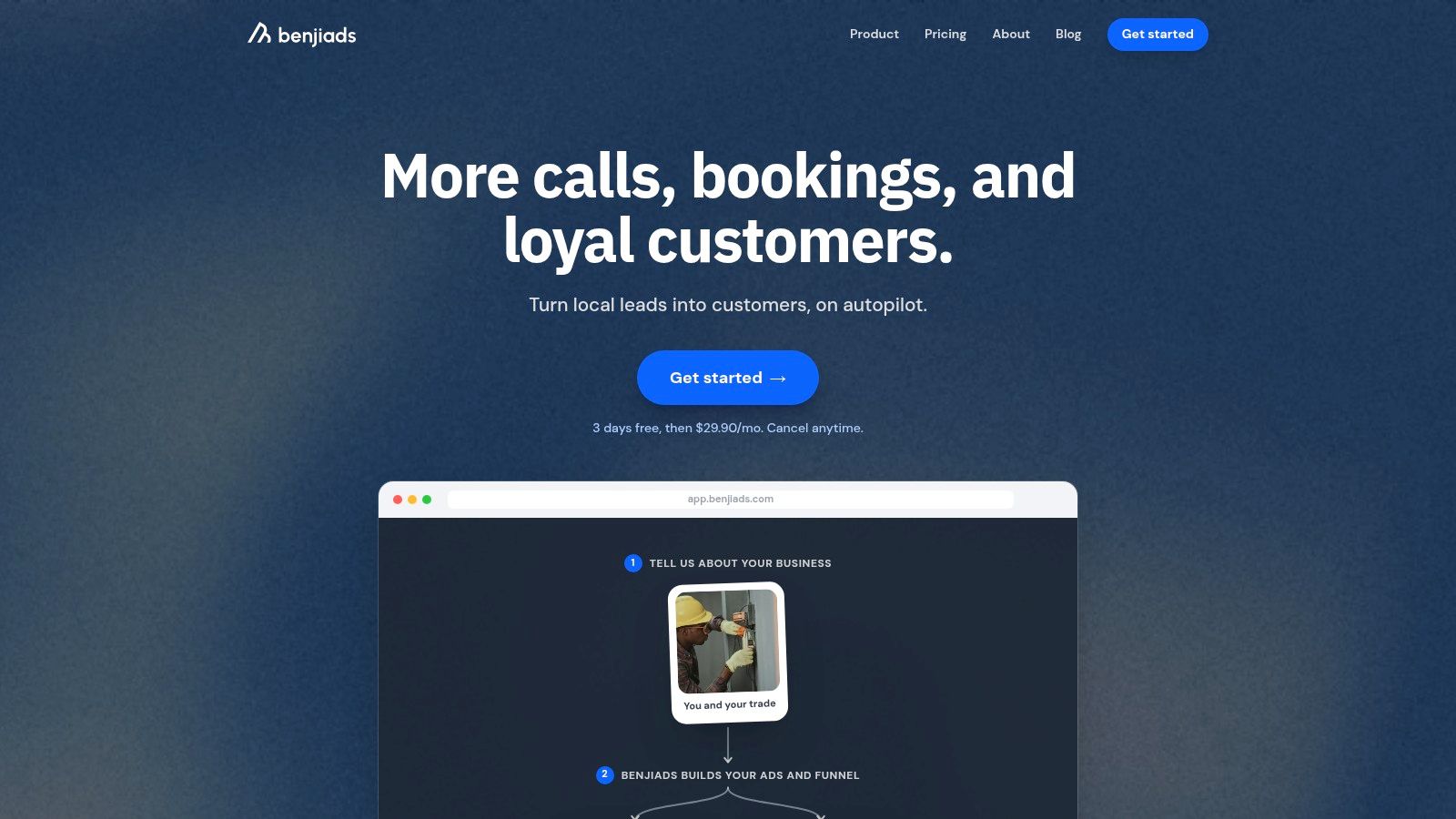
benjiads is software for local service businesses that automates a large part of online advertising and lead follow-up. It generates creatives and copy with AI, launches campaigns on Google and Meta, tracks performance with server-side and client-side signals, and follows up with leads by text. Owners still approve campaigns before they go live, which matters if you don't want a black-box system spending money without oversight.
Where it fits well
This kind of platform is most useful in a few specific situations:
The owner is stuck in DIY mode and ad setup keeps slipping behind field operations
The company has leads but weak follow-up, so opportunities go cold before booking
Tracking is fragmented, which makes channel decisions guesswork
The business needs one stack for creative, launch, retargeting, and text follow-up rather than a string of separate tools
Its trade-specific templates are a practical advantage. HVAC businesses usually don't need a blank canvas. They need campaigns, funnels, and follow-up flows tuned to local service intent.
The trade-off versus agency or in-house
Compared with a traditional agency, benjiads shifts more of the media-buying and creative production process into software. That can reduce management overhead and speed activation. Compared with fully in-house execution, it removes a lot of setup friction, especially for contractors who don't have a dedicated performance marketer.
The decision comes down to operating model. If you want strategy-heavy consulting, complex multi-market coordination, or a broader SEO and web program, a full agency or in-house team may still be the better fit. If your bottleneck is getting campaigns live, tracking outcomes, and following up with leads quickly, a productized system can make more sense.
The strongest point in its favor isn't novelty. It's workflow compression. HVAC marketing usually breaks at handoffs. Creative sits with one person, ads with another, tracking with a freelancer, and follow-up with the CSR team. A combined stack reduces those gaps.
Paid Search and Local Services Ads That Actually Book Jobs
In HVAC, paid media wins or loses on cost per booked job. Creative matters, but channel allocation matters first.
The 2026 benchmarks cited earlier point in the same direction. Local Services Ads usually produce cheaper leads than standard Google Ads, and those leads often book at a higher rate. Standard search still matters because it gives more control over intent, landing pages, exclusions, and offer framing. The mistake is treating those channels as interchangeable.
HVAC paid channel economics in practice
A $50 lead that books cleanly is worth more than a $100 lead that ties up the CSR team and never turns into revenue. That sounds obvious, but plenty of HVAC accounts are still optimized to form volume or platform-reported conversions instead of booked calls.
Use a simple ranking framework:
LSAs for high-intent local demand you can answer fast
Branded search to protect existing demand and keep competitors from skimming it
Non-branded search for service-line growth, with tighter controls on query quality
Performance Max only after offline conversion tracking and exclusions are working
That order reflects economics, not preference.
How to set up LSAs so they produce booked calls
LSAs underperform for predictable reasons. Coverage areas are too broad. Hours do not match phone coverage. Job types are selected loosely. Lead disputes go untouched. Nobody reviews which leads were booked, missed, duplicate, or junk.
A workable setup includes:
Current licensing and insurance
Service areas based on profitable dispatch zones, not map vanity
Business hours aligned to real answer coverage
Tight service categories that match your actual work mix
A weekly dispute and lead-quality review
Disposition tracking for booked, lost, bad, duplicate, and missed leads
Speed matters here. If your team takes twenty minutes to return an emergency call, the platform did its job and your operation did not. For HVAC, speed-to-lead is part of media performance.
Contractors also need to understand the verification path attached to their profile and how that badge appears to homeowners. That affects trust at the moment of click and call.
Search campaign structure should follow homeowner intent
Search accounts waste money when repair, install, maintenance, and branded demand are bundled together. Bids blur. Ad copy gets generic. Landing pages do too much. Query matching loosens and irrelevant traffic slips in.
Split campaigns by intent:
Emergency repair
AC installation
Heating service
Maintenance plans
Brand defense
Then build the experience around the job type. Emergency traffic needs call-first layouts, trust signals, and clear service-area language. Replacement traffic needs financing, warranties, and stronger qualification. Brand campaigns need tight copy and low-friction paths to contact.
The account should mirror how the homeowner shops, not how the marketing team wants to simplify reporting.
A budget split that fits a single-market HVAC operator
For a typical single-market contractor, I usually put budget into the surfaces closest to booked jobs first.
A practical order:
Fund LSAs to efficient volume
Keep branded search covered at all times
Scale non-branded service campaigns by margin and season
Use retargeting as support
Treat broad display and loose social lead gen cautiously
That last point saves budget. Broad display can create cheap leads on paper and weak booking outcomes in the actual marketplace. Poorly configured Performance Max can do the same if it is fed bad conversion signals.
The optimization levers that actually move results
Once campaigns are live, the biggest gains usually come from operations and account structure, not headline testing.
Focus on:
Dayparting based on answered-call coverage
Device adjustments when call intent outperforms forms
Negative keyword expansion
Offline conversion imports tied to booked jobs
Call reviews for CSR quality, missed urgency, and bad qualification
Geo trimming by close rate and average ticket, not just lead count
A lot of HVAC programs stall at this point. The ad account looks active, but nobody is feeding booked-job data back into Google, nobody is listening to calls, and nobody is cutting low-value ZIP codes. Spend keeps flowing. Efficiency does not improve.
Paid search can scale HVAC revenue. It can also burn money fast. The difference is usually response speed, clean channel priorities, and whether the account is optimized for booked work instead of raw lead volume.
Seasonal Content and Social Tactics for Demand Spikes
Content and social don't carry HVAC acquisition the way search does. They do something different. They help absorb seasonal demand, reinforce trust, and create useful touchpoints before and after high-intent search moments.
That's the right frame. If you expect Instagram Reels to replace emergency search demand, you'll be disappointed. If you use content and social to support seasonal buying cycles, they become much more valuable.
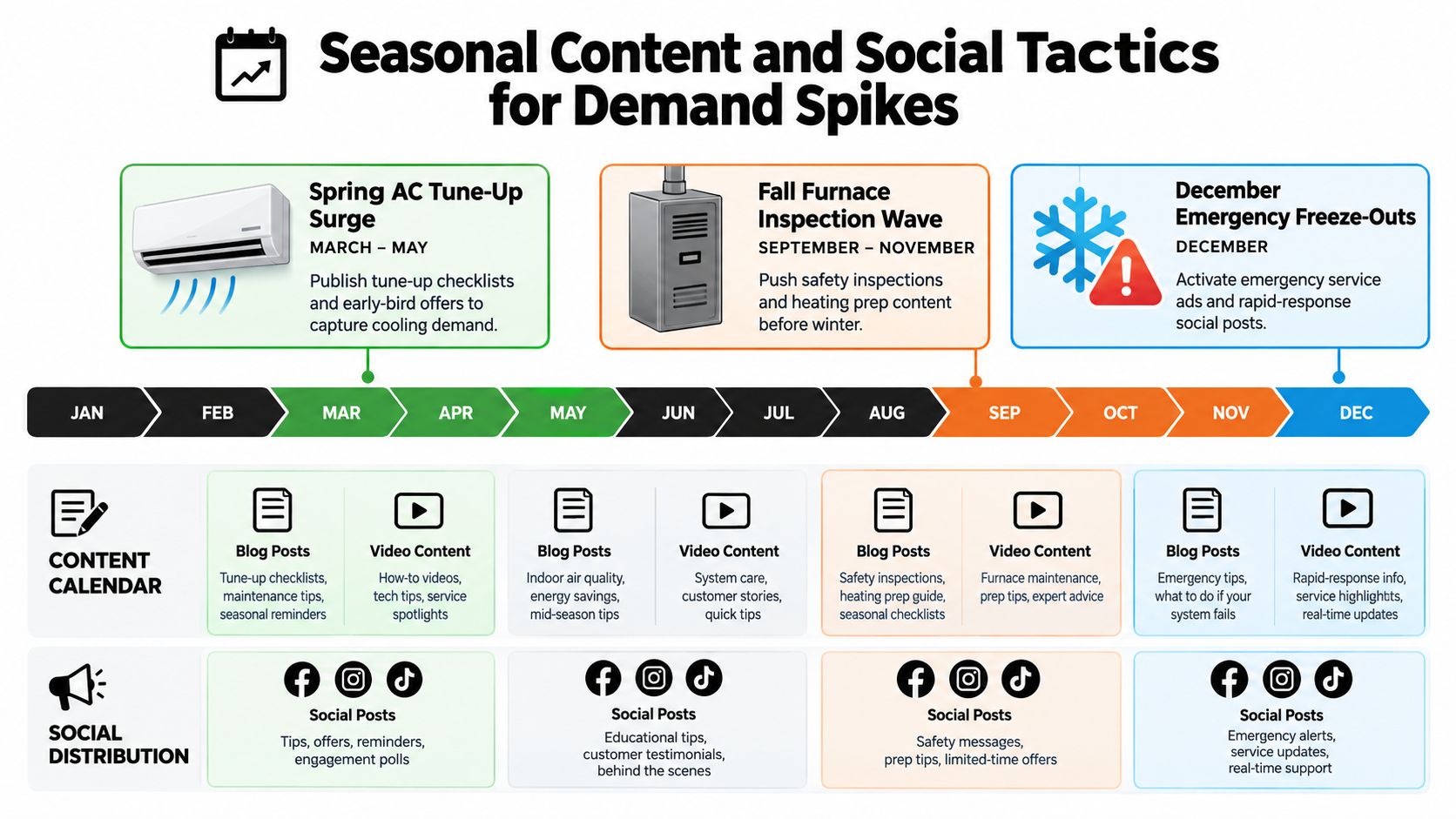
Spring through summer content rhythm
Late winter into spring is the moment to publish and promote preventive cooling content before the rush hits.
A workable rhythm:
February to April blog topics
AC tune-up checklist before warm weather arrives
Should you repair or replace your aging air conditioner
Short-form video angles
Technician walking through the most common pre-season AC issues
Quick explainer on signs an outdoor unit needs service
Ad amplification
Maintenance-focused offers
Financing messages for replacement shoppers
Retargeting for visitors who viewed cooling pages but didn't book
By May and June, urgency rises. The creative should shift with it. Repair messaging should become more direct, and landing pages should lean harder into same-day availability, click-to-call, and dispatch clarity.
Mid-summer through winter demand windows
In the hottest months, ductless, heat pump, and emergency service content tends to carry more weight than broad educational pieces. Then the calendar flips and heating prep takes over.
Use this sequence:
July to August
Heat pump service content
Ductless installation explainers
Video proof of installs, technician walkthroughs, before-and-after swaps
September to October
Furnace inspection reminders
Heating system safety checks
Seasonal tune-up promotion content
November to December
No-heat emergency pages
Frozen system and winter breakdown guidance
Fast-response creative with visible phone actions
Social is strongest here as a trust-signal layer. Homeowners checking your brand after finding you in search often look at your recent posts, team photos, service videos, and review activity. An active account reassures them that you're a real local operator, not a lead-gen shell.
What to publish and what to avoid
Good HVAC content usually has one of three jobs:
Solve a homeowner question
Support a service decision
Strengthen confidence before contact
Weak HVAC content tends to miss all three. It's often generic, over-optimized, or disconnected from services you want to sell.
A practical content mix looks like this:
Educational posts tied to maintenance and troubleshooting
Decision-support pages for repair-versus-replace and system selection
Proof content showing real technicians, real installs, and local service context
Seasonal reminders distributed through blog, social, email, and retargeting
The best HVAC content doesn't chase trends. It answers the question a homeowner has right before they call.
Lead Management, Nurture, and Speed-to-Lead Workflows
A lot of contractors think they have a lead-generation problem when they have a lead-management problem.
That confusion is expensive. You can buy more traffic, improve rankings, and launch new campaigns, but if inbound leads sit untouched or get weak follow-up, booked revenue stalls anyway. In HVAC, speed-to-lead isn't an optimization detail. It's part of the offer.
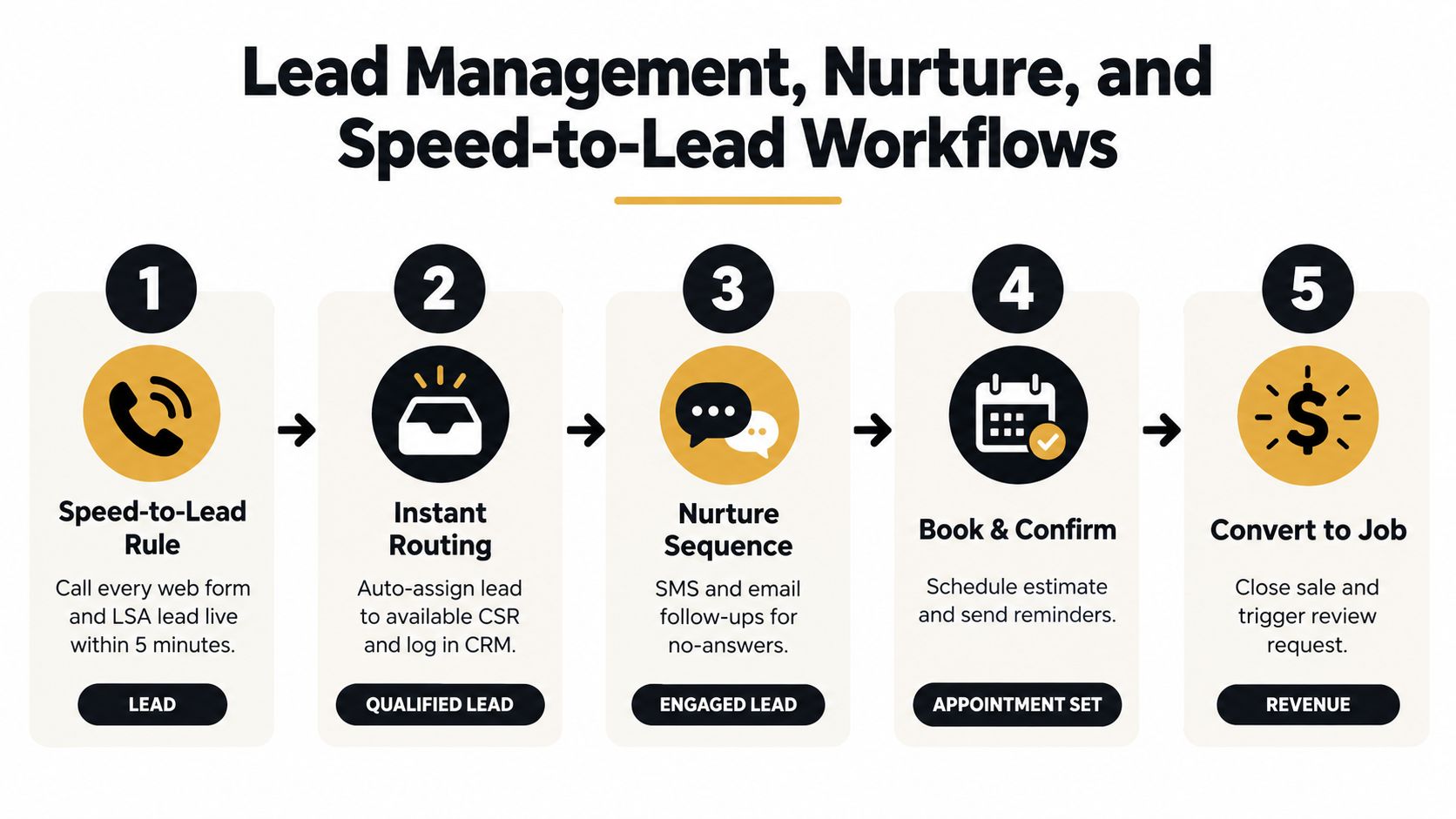
The first minutes decide too much to improvise
Every web form and LSA lead should trigger an immediate workflow:
Call right away from a live rep if one is available.
Send a text quickly if there's no answer.
Route the lead in the CRM to an accountable person, not a shared void.
Log source, job type, and urgency before the trail goes cold.
This requires an actual on-call rotation. If no one owns after-hours or overflow response, the SLA exists only on paper.
CRM stages need exit criteria
A CRM becomes useful when stages reflect operational reality, not just sales jargon.
The core stages I'd use are:
New Lead
Required fields captured, source assigned, first outreach pending or in progress.Contacted
Initial call or text attempt completed, outcome recorded.Qualified
Service area, service type, and fit confirmed.Scheduled
Appointment set with date, time window, and assigned rep or technician.Completed
Job done, outcome closed, review and follow-up automations triggered.Lost
Reason logged clearly, such as price, no response, outside area, competitor won.Nurture
Prospect didn't book yet but remains viable for follow-up.
The hidden value here is reporting discipline. If “lost” and “nurture” are used loosely, channel analysis becomes unreliable because no one can tell whether a lead source was weak or the process was.
Nurture should match HVAC buying cycles
Not every lead books on the first call. Replacement estimates especially go quiet while homeowners compare options, discuss financing, or delay the decision.
That's where a structured follow-up sequence helps:
Replacement estimate follow-up
Short SMS check-in
Email restating options
Reminder about timing, efficiency, or financing if relevant
One-time repair customers
Maintenance-plan invitation after the service experience is still fresh
New installs
Later check-in that confirms satisfaction and asks for a review or referral
Email still matters here when it's tied to clear customer segments and useful reminders. This guide to email marketing ROI and strategy is helpful for building a workflow that supports revenue rather than just sending newsletters.
Call tracking and QA close the loop
Once calls are recorded and reviewed, you stop guessing why some channels “don't work.”
The minimum setup:
Dynamic number insertion on the website
Dedicated tracking numbers per major channel
Call recording and transcription
Weekly QA review
Scorecards for contact rate, qualification quality, and booking outcome
Some campaigns don't fail because of targeting. They fail because the rep didn't answer with urgency, didn't ask the right qualification questions, or didn't offer a clear next step.
Good attribution doesn't just identify which ad drove the lead. It exposes which team action won or lost the job.
Once booked jobs are tagged cleanly, push that outcome data back into ad platforms as offline conversions. That gives bidding systems better optimization signals and gives management a truer picture of cost per booked job.
KPIs, 90-Day Optimization Plan, and Final Checklist
If you only monitor leads, you'll eventually overfund noisy channels and underfund profitable ones. HVAC operators need a reporting stack tied to booked work and revenue quality.
The KPI set should stay tight. Too many dashboards turn attention into theater.
HVAC Marketing KPI Benchmarks for 2026
KPI | 2026 Target | Trigger Action |
|---|---|---|
Qualified leads by channel | Increase channels that consistently produce serviceable, bookable demand | Reallocate spend away from low-fit sources |
Speed-to-lead median | As fast as operationally possible, with live-call discipline | Add routing, overflow coverage, and instant SMS |
Booking rate | Improve steadily by channel and by CSR or rep | Review call handling and landing-page alignment |
Cost per booked job | Track from actual booked outcomes, not raw leads | Shift budget to higher-yield campaigns |
Average ticket by source | Compare repair, maintenance, and replacement mix | Separate campaigns by job type |
Review velocity | Maintain a steady flow, not sporadic bursts | Automate post-job review asks |
Google Business Profile actions | Monitor calls, clicks, and direction intent qualitatively | Refresh profile content and review operations |
Notice what's missing. Pageviews, impressions, and generic engagement don't belong at the top unless they directly explain a booking outcome.
A practical 90-day optimization cadence
Days 1 to 30 should focus on measurement and cleanup. Confirm tracking numbers, CRM source capture, booked-job tagging, and page-level conversion paths. Fix obvious gaps before making major budget calls.
Days 31 to 60 should focus on allocation. Review LSA quality, brand defense spend, non-branded campaign efficiency, and whether low-intent channels are taking too much budget. Tighten negatives, pause waste, and move spend toward campaigns tied to real dispatches.
Days 61 to 90 should focus on iteration. Improve landing pages, offers, ad messaging, and follow-up workflows using the booked-job data you now trust. This is the stage where creative tests become useful because the operating system underneath them is stable.
Monday morning checklist
Use this as an operator's audit list:
Google Business Profile is claimed, complete, and actively managed
Citations are consistent across major maps, directories, and trade portals
Reviews are requested through an automated post-job workflow
Website prioritizes click-to-call and service-intent pages
LSA setup is verified and reviewed weekly for lead quality
Paid search is segmented by service line and buying intent
CRM stages are defined with clear exit criteria
Speed-to-lead SLA is documented and owned by named staff
Call tracking is installed by channel
Reporting connects spend to booked jobs, not just inquiriess
The companies that grow most efficiently in HVAC usually aren't doing mysterious things. They're visible where intent is highest, fast when leads arrive, disciplined about tracking, and ruthless about cutting channels that don't book work.
That's what effective marketing for HVAC companies looks like in practice. It isn't louder. It's tighter.
Copyright 2026 - Reklam5: Dijital Ajans ·  tarafından desteklenmektedir
tarafından desteklenmektedir