Best Advertorial Generator for DTC Brands: 2026 Guide

7 NOVEMBER 2026
You've got a product ready, creative queued in Meta, and two weeks to prove cold traffic can buy without sending everyone straight to a product detail page. That's where the page becomes the bottleneck. It has to read like editorial, repeat the promise in your ad, load fast on mobile, and go live without waiting on a developer who is already booked out.
Most tools that call themselves the best advertorial generator for DTC brands solve only the writing part. They hand you copy. You're still left checking claims, fixing the layout on a phone, wiring up tracking, and duplicating the page four ways to test angles. That extra work is where launches slip and where cheap tools stop being cheap.
This comparison judges eight options by workflow, not feature count. How close is the first draft to launch-ready? Does it publish inside Shopify or somewhere else? How much copy and claim checking remains on your team? And can you test variants cleanly before you scale spend?
Trust is part of that test, too. Nielsen's 2021 global study, covering more than 40,000 consumers, found 88% trusted recommendations from people they knew more than any other measured channel, according to Nielsen's 2021 Trust in Advertising findings. An advertorial borrows that recommendation format. If the proof is vague or invented, you're spending trust you haven't earned.
Table of Contents
- 1. Landra
- 2. Landra
- 3. AutoPage
- 4. StoryClicks
- 5. Octet Prow
- 6. Fudge
- 7. Realize Advertorials
- 8. Replo
- 9. Shogun
- How the eight advertorial generators compare on publishing, entry cost, and testing
- Choosing Your Advertorial Stack A Practical Decision Path
1. Landra
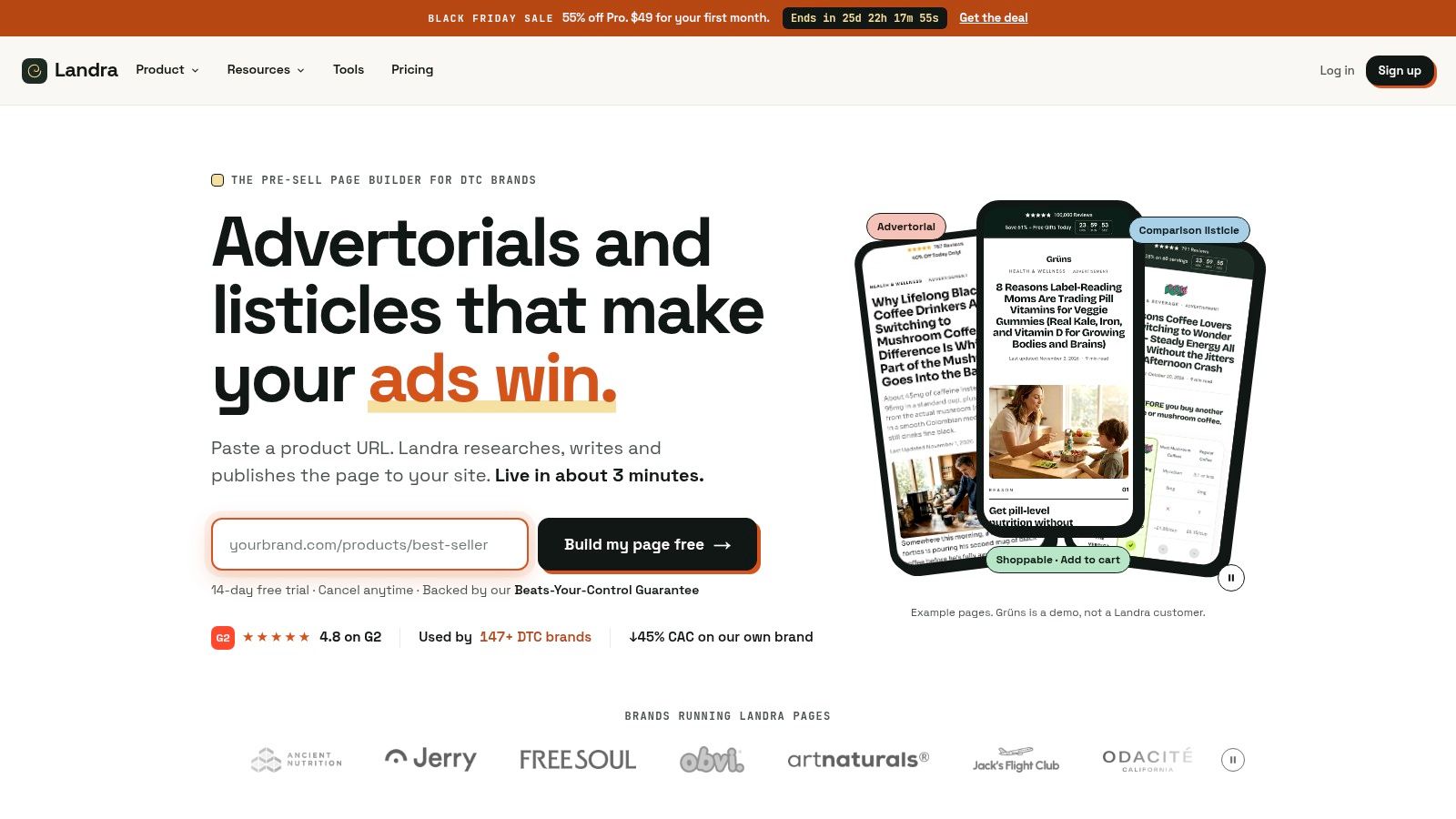
If your bottleneck is getting a complete pre-sell page live this week, start here. Landra's AI advertorial generator reads your brand or product URL and generates the page you'd otherwise brief out. Copy, section structure, headlines, and images arrive together in an editable, mobile-first layout. You click any element to rewrite it inline, swap images, or reorder sections.
That URL-first input matters more than it sounds. The draft uses your live site context, including offers, reviews, and product details, so you're editing a structured argument instead of a blank canvas with lorem-style filler. You're still responsible for checking every claim. The difference is you start from your own product facts, not generic DTC copy you have to strip out line by line.
What you can build with it
- AI advertorials: Narrative, editorial-style pages for cold Meta and TikTok traffic that needs context before price.
- AI listicles: Ranked, scannable comparison and best-of formats for shoppers already comparing options.
- AI pre-sell pages: Shorter warm-up pages that bridge an ad click and your checkout.
- Publishing flexibility: Send pages to Shopify, a Landra-hosted URL, Webflow, or export clean HTML for your existing stack.
Saved brand context carries into future drafts, and you get multiple headline options plus hero templates at generation. Pro adds AI image generation and section-level rewriting with feedback. The free Headline Analyzer, Conversion Rate Calculator, and Advertorial Compliance Checklist are useful even before you pay, especially the compliance checklist, because disclosure and claim discipline are where teams get sloppy under deadline pressure.
I recommend Landra when one person owns ads and pages and can't wait on a copywriter, a designer, and a developer in sequence. Duplicate a page, change the opening angle, and split traffic in your ad platform. It won't replace your checkout or funnel. It does remove the slowest step, which is getting a credible first page in front of real traffic. Starter, Pro, and Pro Plus plans include a 14-day free trial, with generation and storage limits rising by tier.
2. Landra
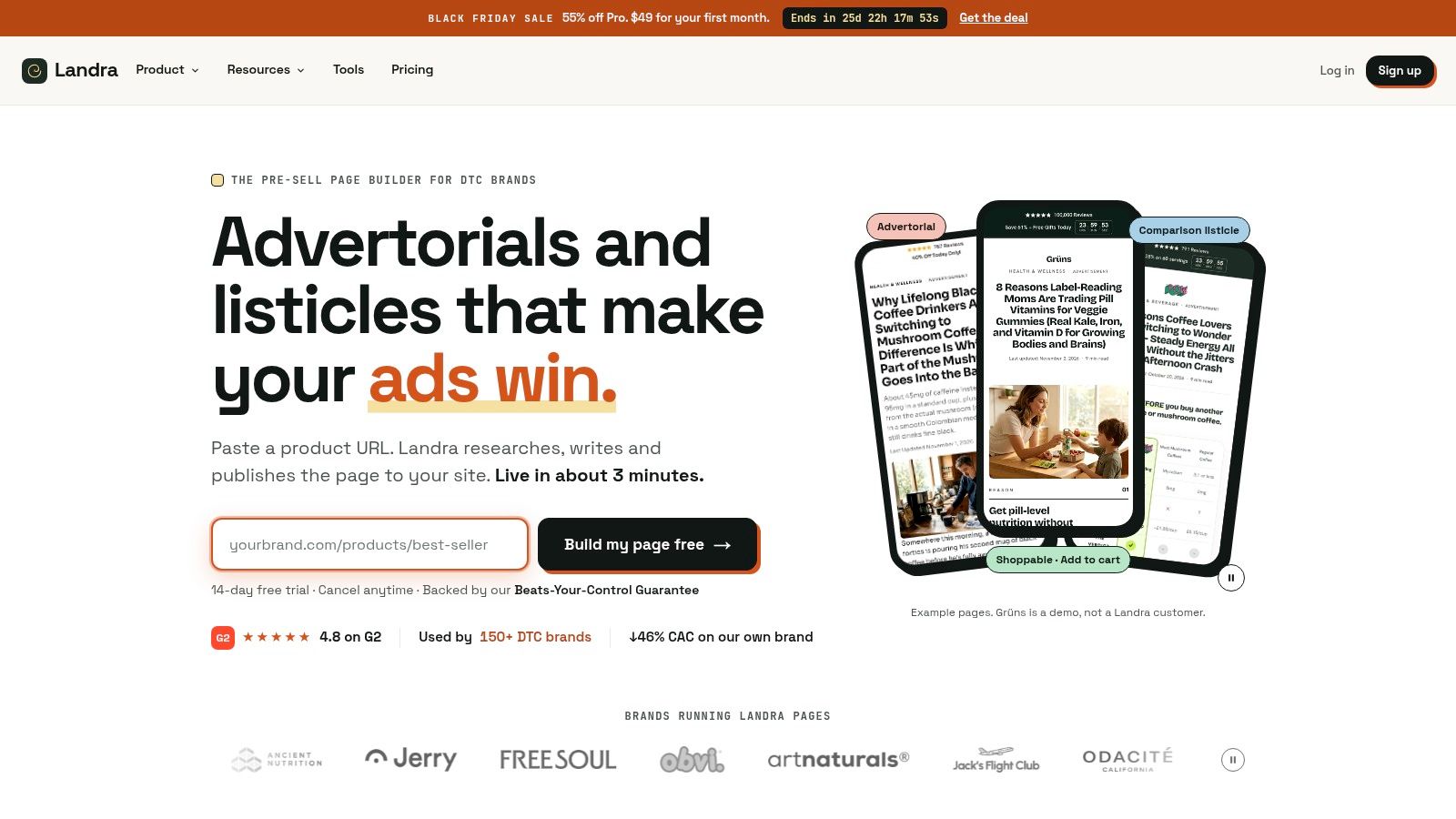
Yes, Landra appears twice in testing shortlists for a reason worth stating plainly. It is narrow on purpose. It generates advertorials and listicles from a product or brand URL, then gives you an editor. It doesn't try to be your store builder, your email platform, or your checkout.
Start with the URL and the audience you're targeting. Landra generates page copy, sections, headlines, and AI images in one pass. You edit inline, duplicate the page, and change one controlled variable at a time, such as the headline, the lead angle, or the proof block. That discipline is what makes variant testing readable later.
Publishing covers Shopify, Landra-hosted URLs, Webflow, WordPress, Framer, and GoHighLevel. That spread suits teams whose store lives in one place and whose campaign pages live in another. You don't need custom development to get a page out of the tool.
Practical rule: Duplicate first, then edit. If you rewrite the original page to test a new angle, you've destroyed your control and your results mean nothing.
The limits are real and you should price them in. Landra is relatively new, so independent review history is thin compared with older page builders. There's no full funnel here, no checkout, no post-purchase upsells, and no built-in A/B testing. You duplicate pages and split traffic in Meta or TikTok instead. Generation and stored-page limits vary by plan, so high-volume testers should check the tier math before committing.
Pick it if pre-sell pages for cold traffic are your recurring job and speed to a testable draft beats having every funnel feature in one login.
3. AutoPage
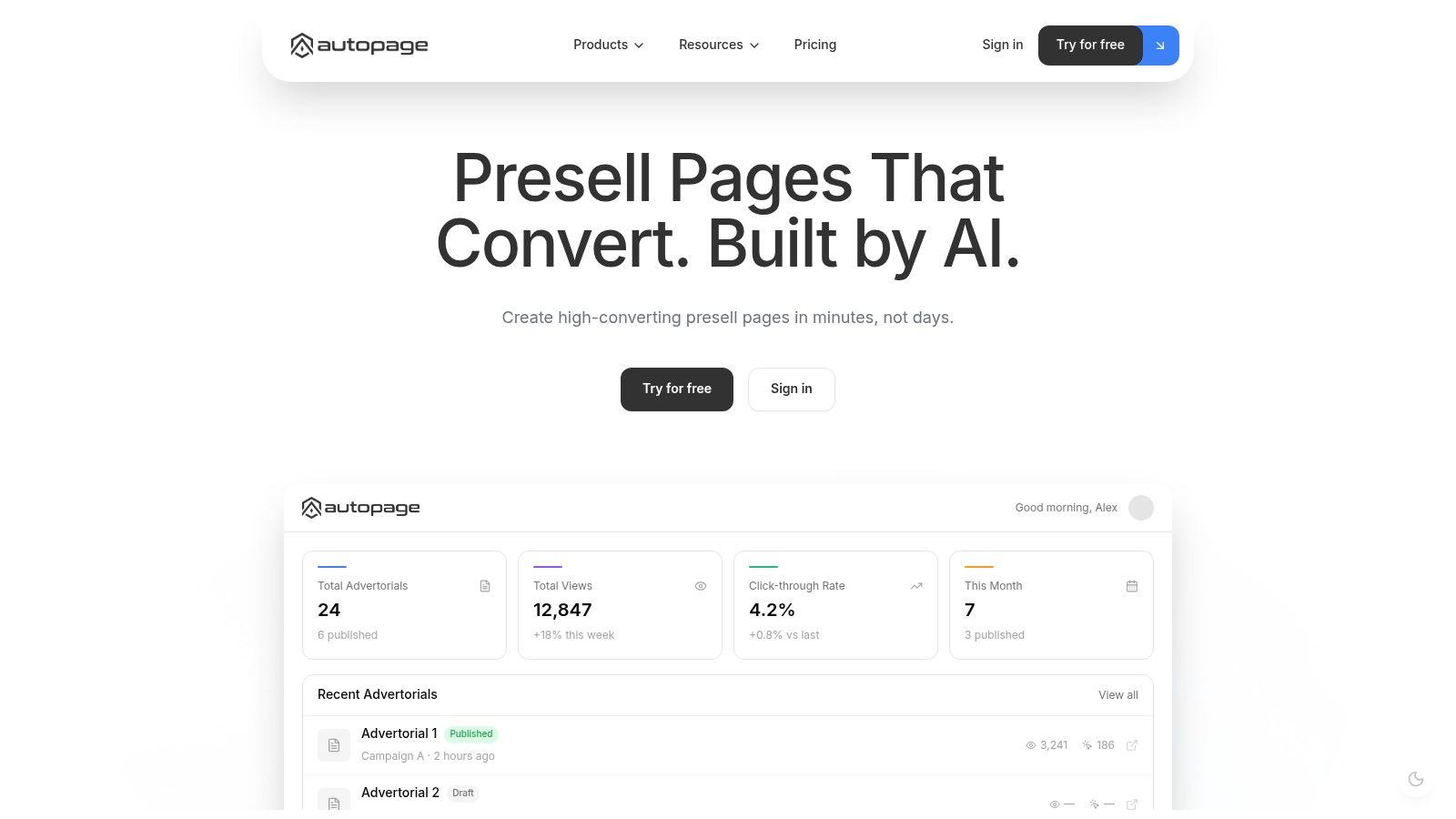
Say you want to test whether advertorials work for your product at all, and you don't want to buy anything yet. AutoPage is built for that first experiment. It turns a product URL into an editable, publishable page and lists a free plan to get you there.
The workflow is import, generate, edit, publish. AutoPage pulls in your Shopify product information and images, then generates editorial-style copy, headlines, testimonials, and calls to action. A visual editor handles copy and image changes. The listed free plan includes live pages, analytics, and custom-domain setup, with no credit card required. That's a low-risk way to put a pre-sell page in front of Meta, TikTok, or Google traffic.
Channel choice shapes which page you should generate, so it helps to think through how Google Ads and Meta Ads compare by industry before you write for both the same way. Search traffic usually arrives with intent and needs proof fast. Social traffic arrives cold and needs the problem framed first.
Now the trade-offs. Confirm free-plan usage limits and current paid-plan availability before you build a launch around them, because terms on newer tools shift. Above all, treat every generated testimonial and benefit claim as unverified until you check it against your actual product data and real reviews. A generated testimonial you can't attribute to a real customer isn't copy. It's a liability sitting above your buy button.
AutoPage also lacks the long track record mature builders carry. I'd use it to validate the format cheaply, then decide whether the workflow holds up when you need ten variants, not one.
4. StoryClicks
One brand, one page a month? StoryClicks is probably more tool than you need. Several brands, several markets, pages shipping every week? Now its shape starts to make sense.
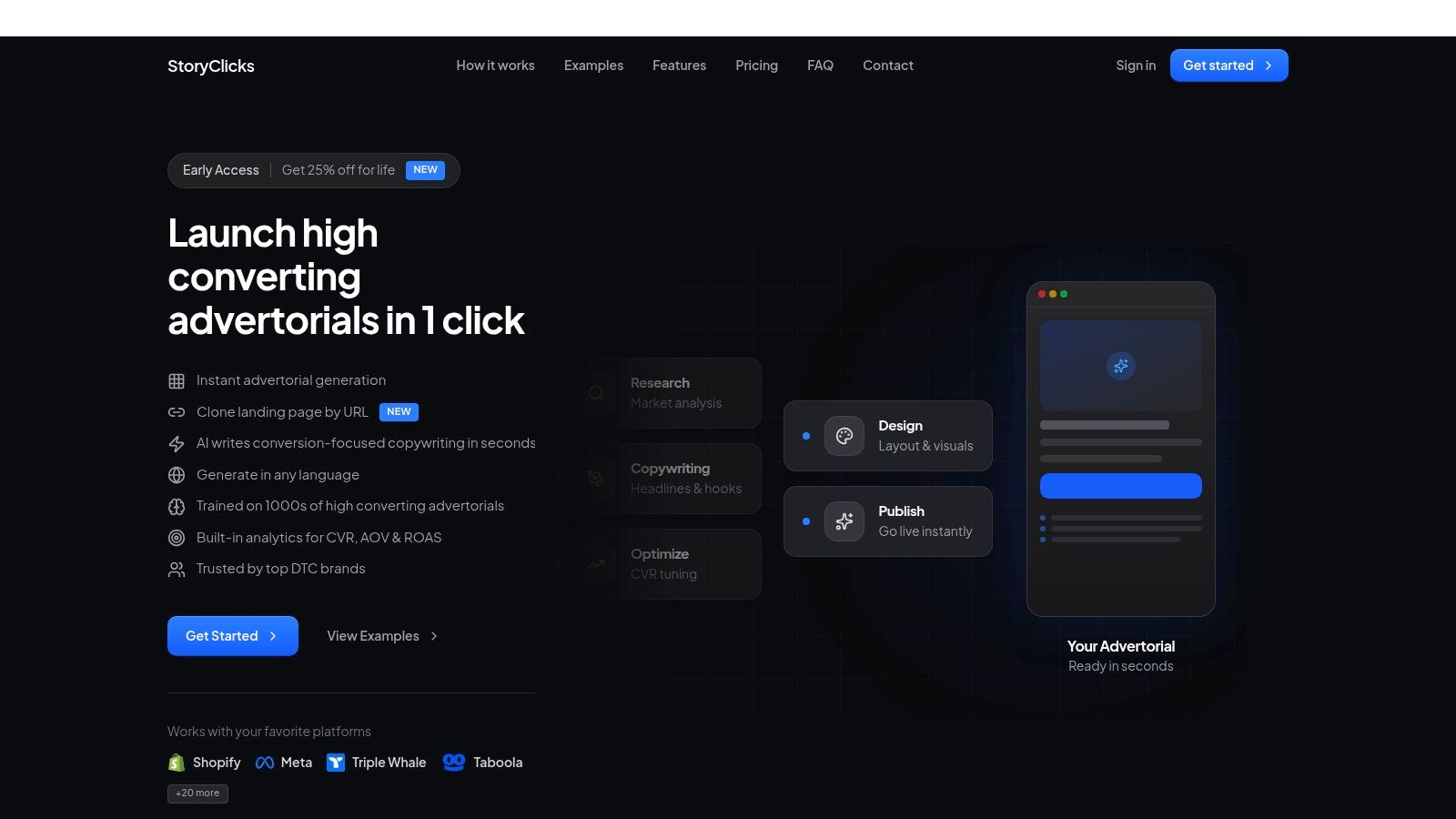
StoryClicks generates advertorials from a product and a defined target audience, pulling product details, images, and pricing into the page. It can clone an advertorial from a URL, which helps when a competitor's structure is clearly working and you want the skeleton, not their copy. Multilingual generation matters for teams selling across markets, though you'll still want a native speaker reading for idiom and claim norms in each language.
Its analytics go past page views. StoryClicks reports metrics such as conversion rate, average order value, and ROAS, and connects with Shopify, Meta, Triple Whale, and Taboola. That connection list tells you who it's for. This is built for teams already measuring post-click performance seriously, not for a founder checking Ads Manager on a phone.
Context on why owned pages carry this measurement weight: the IAB and PwC Internet Advertising Revenue Report recorded $258.6 billion in U.S. internet advertising revenue in 2024, up 14.9% year over year. In a market that crowded, the page after the click is one of the few assets you fully control.
Pricing is the friction point. Plans scale by page and generation capacity, with support options and custom domains included, but the cost can be high if you publish occasionally. Verify integration behavior against your own storefront and attribution setup before you trust the ROAS numbers, and always run generated pages against a control. A dashboard is only useful if it matches your source of truth.
5. Octet Prow
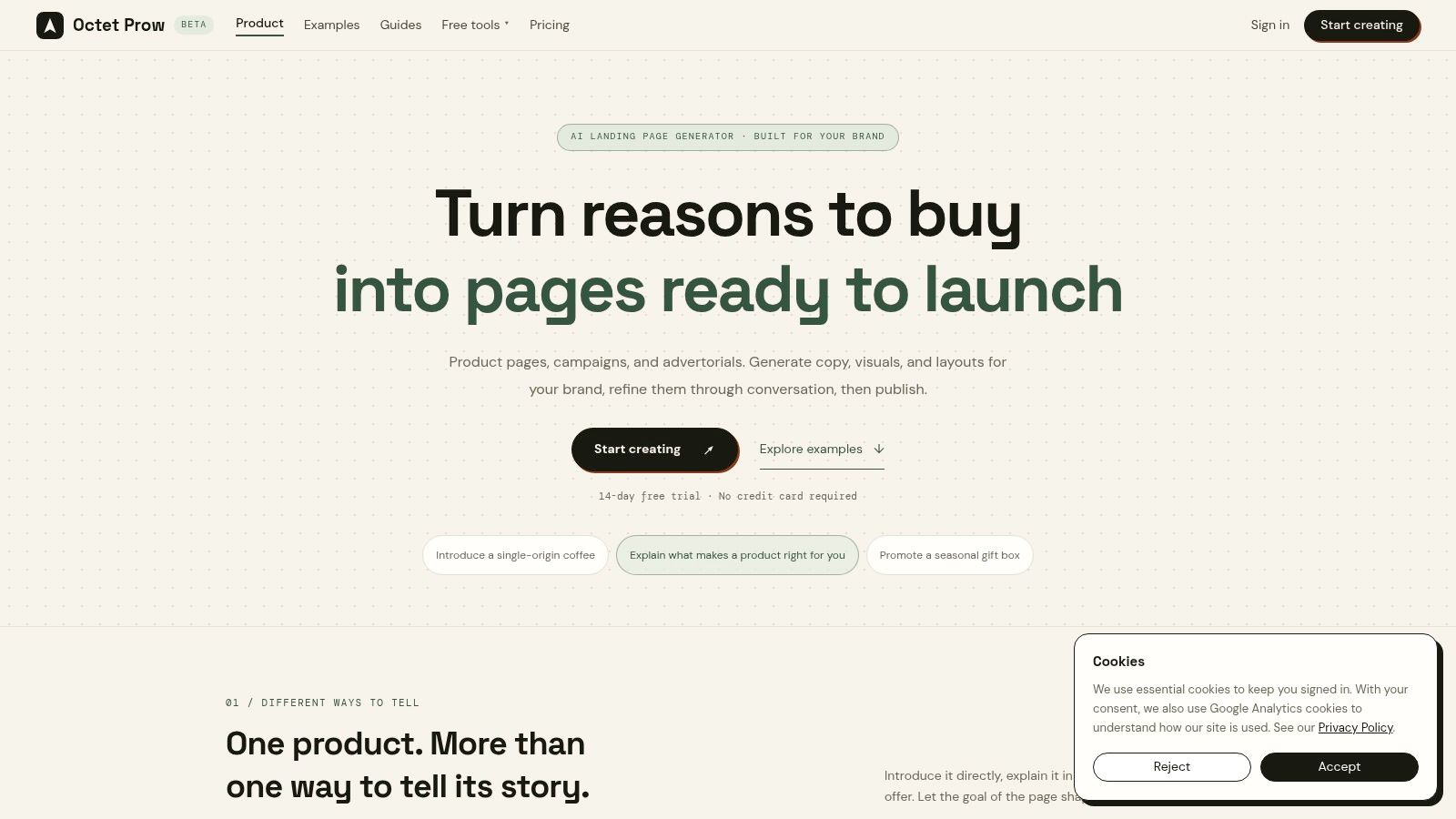
Don't buy Octet Prow as a dedicated advertorial machine. Buy it if advertorials are one of several page types your team ships and you'd rather keep them in one project-based system.
Describe what you need and it generates copy and layout for product pages, campaign pages, and advertorials. You edit and publish from there. A brand design system holds your colors, typography, and spacing, so generated pages don't drift off-brand every time a different teammate builds one. Responsive canvas sizes let you check mobile, tablet, and desktop before anything goes live, which sounds basic until you've launched a page that only looked right on the designer's monitor.
Where it fits and where it strains
- Fits agencies and multi-brand teams: Projects organize neatly by brand or client, so assets and settings don't bleed across accounts.
- Strains on depth: General-purpose generation means advertorial drafts often need substantial editing to build a real editorial arc.
- Strains on volume: Project, page, and AI limits cap output, and the higher-volume plan costs considerably more than the entry tier.
Octet Prow supports publishing and A/B tests depending on plan, and advertorials appear across its listed paid plans. There's a 14-day trial without a credit card, so you can test the thing that matters. Generate one advertorial for your hardest product and time how long editing takes before it's publishable. If the edit takes as long as writing from scratch, the generation isn't saving you anything. If it cuts the job in half across campaign, product, and pre-sell pages, the broader scope earns its price.
6. Fudge
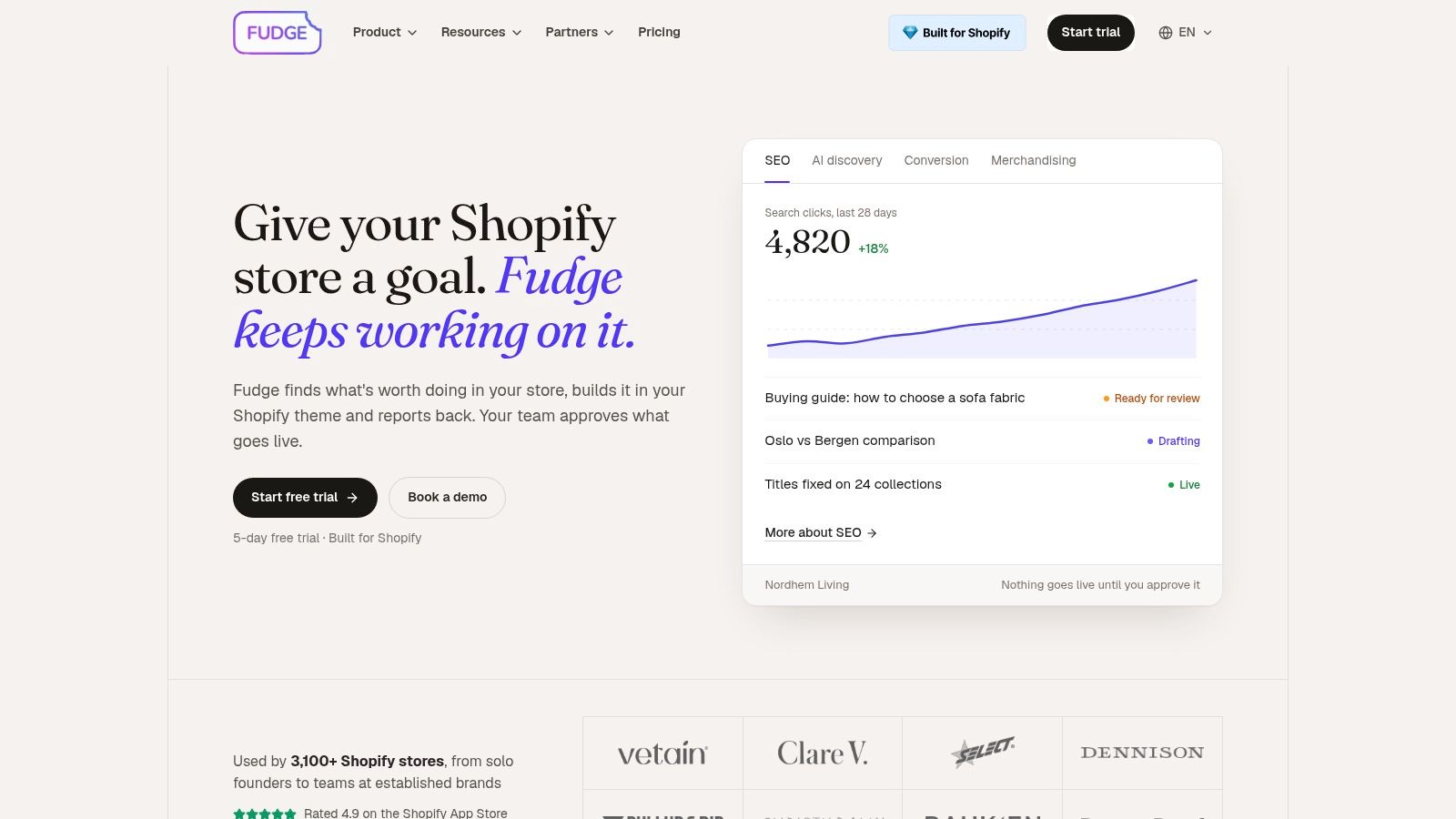
The question with Fudge isn't quality. It's whether you want your pages living natively inside Shopify, because that's the whole bet.
Fudge is an AI-powered Shopify page builder that generates advertorials alongside campaign and product pages. It works from prompts and can take your ad copy or creative as input, which is the right instinct. Message match between the ad someone clicked and the page they land on is where pre-sell pages win or bleed money. Feed it the winning ad and the page starts from the promise that already earned the click.
The technical difference is real. Fudge generates native Liquid, CSS, and JavaScript inside your Shopify theme and can use your theme, products, and brand styling as context. Your page isn't dependent on a separate app-rendered layer, your pixels and Shopify analytics stay where they are, and you publish through Shopify itself. Prompt-based editing handles revisions without opening a code editor. The vendor site and Shopify App Store listing report a 4.9 rating.
AI assistance is normal now, not a differentiator. Gartner survey data cited in Search Engine Journal's reporting on marketer AI adoption found 73% of marketing teams use generative AI, with creative development the leading use at 77% among users. What separates tools is control. Fudge keeps you close to your theme and your store data.
Costs are the counterbalance. Monthly pricing is higher compared with lightweight generators, and the workflow only supports Shopify. Multi-platform teams require a different solution. Human review is essential here, particularly for regulated or evidence-sensitive claims, because native theme output means a bad claim publishes into your real store, not a sandbox.
7. Realize Advertorials
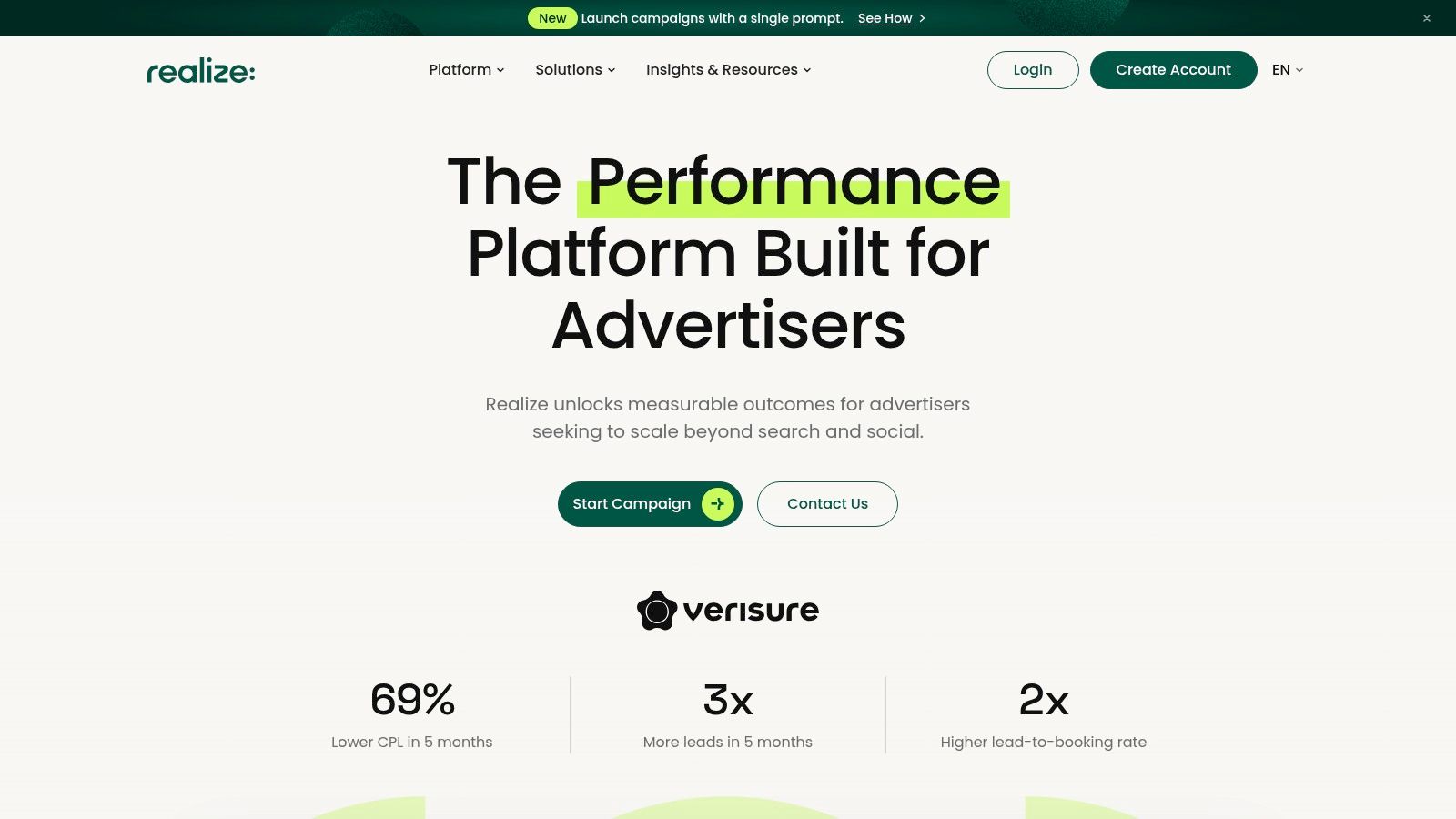
Already buying native traffic through Realize and Taboola? Then Realize Advertorials removes steps you'd otherwise do by hand. Not on that platform? Skip this one entirely, because the value is the integration.
The builder sits inside the Realize advertising platform and creates editorial-style landing pages without separate design software or hosting. Your ad account and your landing page live in the same system, so there's no exporting, no subdomain setup, and no developer ticket to get a page live. It automatically adds Taboola pixel tracking to generated pages, which eliminates the most common native-advertising setup error, the page that launches with no conversion tracking and burns budget blind for a weekend.
Prebuilt page and compliance-oriented components give you a starting structure that fits native placements. Native readers arrive in article mode, so the page has to sustain reading, not just pitch. This is also where channel strategy gets interesting, and weighing influencer marketing against performance marketing helps you decide how much budget belongs in native advertorials versus creator-led formats in the first place.
Disclosure deserves real attention on native traffic. One experimental study found AI disclosure lowered perceived credibility, while research with 554 Italian participants found disclosure increased credibility, comprehension, likes, and shares, as summarized in a four-study advertising paper on AI disclosure. The evidence conflicts, so test disclosure prominence in your own market instead of copying a default.
Practical limits: the advertorial feature is identified as beta, so functionality and availability can change. Public pricing and user-reputation information for the feature is limited. Treat it as a convenience layer on an existing Realize spend commitment, not a reason to adopt the platform.
8. Replo
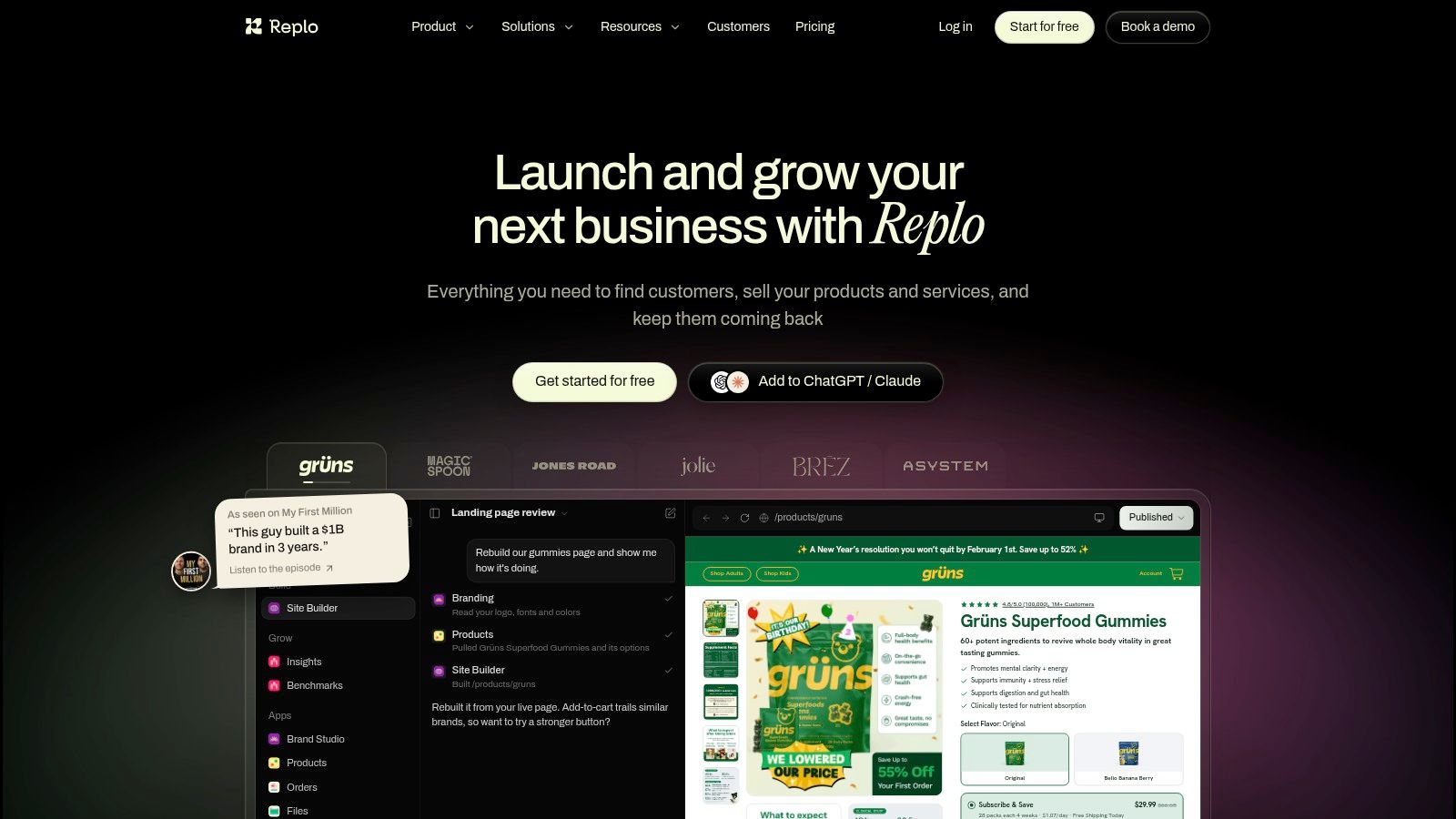
Replo is the control freak's option, and I mean that as praise with conditions. It is a Shopify landing-page platform, not a dedicated advertorial generator. You direct the structure, the copy, and the design. In return you get flexibility format-specific tools don't offer.
Its AI can build from prompts, URLs, Figma files, or ad creative, so an existing design workflow carries over instead of starting again. Pages connect directly to Shopify products, cart, and checkout. That matters for advertorials because a reader who's convinced shouldn't hit a clumsy handoff. With Replo the page can sell, not just send the reader onward. Publishing runs on your brand domain or subdomain, and analytics plus A/B testing options are built in.
That testing capability is the strongest argument here. Understanding conversion rate optimization as the gap between traffic and sales is what turns an advertorial from a one-off launch into a program. Replo supports that program. Generate-elsewhere tools often leave you splitting traffic manually in the ad platform and reconciling results in a spreadsheet.
A page you can't split-test cleanly is a page you can't improve on purpose. You'll improve it by accident or not at all.
The costs show up in two places. Replo costs more than entry-level advertorial generators, and credit and visitor-session limits vary by plan, so heavy paid traffic can push you up tiers. Your team also does substantial copywriting and editing to build a real advertorial narrative. Replo gives you the stage, the cart, and the scoreboard. The story is still yours to write, which is either the point or the problem depending on your bench.
9. Shogun
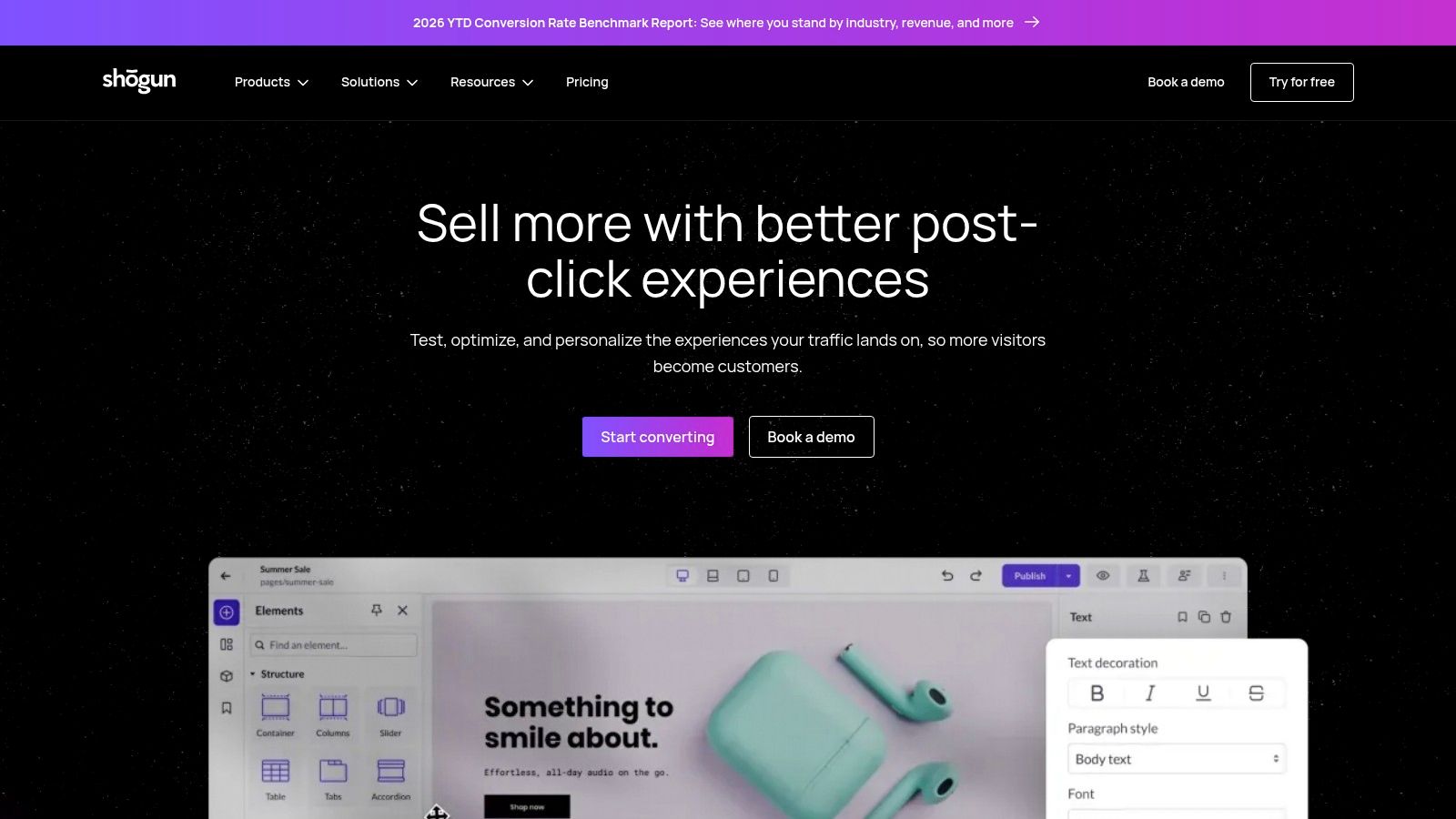
Buy Shogun for the optimization program, not the first draft. It won't generate a complete advertorial story from your product URL. It will help a serious team build, test, and personalize pre-sell pages alongside every other page type in the store.
The visual builder uses reusable content sections, so a proof block or comparison table you build once can appear across advertorials, product pages, and campaign pages without rebuilding. Page analytics, A/B testing, and personalization come on eligible plans. It supports Shopify and other commerce platforms, and higher tiers add multi-store capability for larger operations syncing content across storefronts.
Personalization needs a governor, not just a toggle. Three experiments found an inverted-U relationship in AI-generated advertising, with moderate personalization beating both low and high levels, according to research published in the Asia Pacific Journal of Contents and Research Innovation. Shogun gives you the testing machinery to find your own middle. Test segment-level problem framing before you reach for individualized messaging that can make shoppers feel watched.
Human oversight scales with that machinery. A 2025 Jasper survey found 63% of marketers were already using generative AI and 57% used it for content creation, per Jasper's State of AI in Marketing 2025 report. Adoption says nothing about quality. Build factuality checks, claim substantiation, and approval steps into your Shogun workflow yourself, because the platform won't supply the editorial judgment.
Testing, personalization, and traffic allowances all depend on plan, so map your expected page volume before choosing a tier. For a small brand shipping three pre-sell pages a quarter, this is more software than you need. For a team running advertorials as one track in a wider CRO program, it's the grown-up option.
How the eight advertorial generators compare on publishing, entry cost, and testing
| Item | Publishing Options | Free Entry Point | Testing and Analytics | Best Fit |
|---|---|---|---|---|
| Landra | Shopify, hosted URL, Webflow, or HTML export | 14-day trial; free headline, conversion, and compliance tools | Duplicate pages to test variants; analytics not specified | DTC teams creating mobile-first advertorials and listicles for paid traffic |
| Landra | Shopify, hosted URL, Webflow, WordPress, Framer, or GoHighLevel | 14-day free trial | Create variants for angle testing; no built-in A/B testing | DTC teams that need fast pre-sell page creation across platforms |
| AutoPage | Live pages with custom-domain setup | Listed free plan; no credit card required | Analytics included; test generated claims for accuracy | Advertisers seeking a simple, low-friction way to create and publish pages |
| StoryClicks | Custom domains; Shopify and advertising-platform connections | No free entry point specified | Tracks conversion rate, average order value, and ROAS | Teams or agencies managing multiple brands and campaign pages |
| Octet Prow | Page publishing; A/B tests on eligible plans | 14-day trial without a credit card | A/B testing depends on plan | Brands or agencies needing varied page types and project organization |
| Fudge | Publishes native Shopify theme code | No free entry point specified | Testing and analytics not specified | Shopify teams wanting pages built directly into their store theme |
| Realize Advertorials | Built into the Realize platform | Pricing and free access not specified | Taboola pixel tracking; broader analytics not specified | Advertisers already using Realize and Taboola |
| Replo | Shopify pages on a brand domain or subdomain | No free entry point specified | Analytics and A/B testing options | Shopify teams needing flexible landing pages and storefront integration |
| Shogun | Shopify and other commerce platforms | No free entry point specified | Analytics, A/B testing, and personalization on eligible plans | E-commerce teams running broader conversion optimization programs |
Choosing Your Advertorial Stack A Practical Decision Path
Start with your traffic source and platform, not the feature list. A tool that publishes beautifully to the wrong place just creates a tracking problem you'll debug at midnight. Ask three questions in order. Where does the page have to live? Who on your team writes the first draft, a person or the tool? And how will you know, in numbers, whether the page earned its budget?
If you run Shopify and want pages inside your theme with your cart and pixels untouched, test a native-theme tool like Fudge against a general builder like Replo or Shogun on the same product. If speed to a first testable draft is the constraint, a dedicated generator that starts from your product URL gets you live while a blank-canvas builder is still waiting on copy. If you're already spending on native through Realize, use the integrated builder and spend your saved setup time on disclosure and claim checks instead.
Whatever you pick, set up the test before you generate anything. Keep a control page live, usually your current product page or your best existing pre-sell page. Define a kill metric in advance, such as add-to-cart rate or cost per acquisition at a set spend level, and write it down where the team can see it. Change one controlled variable per variant, whether that's the headline, the lead angle, the proof point, or the offer. Pages that change everything at once produce results nobody can act on.
Then check every generated claim against substantiated product data before a dollar of traffic touches it. Confirm ingredients, certifications, review quotes, and before-and-after language line by line. Keep the source for each factual claim on file, label sponsored content clearly, and remove any testimonial you can't tie to a real customer. This review step feels slow. It's still faster than a platform rejection, a refund spike, or a comment thread pointing out that your page invented a benefit.
Measure past the click. Track qualified-session rate, add-to-cart rate, conversion rate, and customer acquisition cost by variant, and watch refund and complaint rates for pages that convert hard. A page that sells aggressively and refunds heavily isn't a winner. It's a liability with good click-through.
If advertorials are one piece of a wider program, we can help directly here. At Reklam5, we create and manage social media advertising campaigns and provide sales funnel optimization for e-commerce projects, alongside campaign measurement and reporting. That means your pre-sell pages get judged inside the full funnel, from ad promise to checkout completion, not as isolated pieces of copy.
Ready to find out whether your next advertorial actually earns its spend? Talk to Reklam5 about building your paid social and funnel program around pages that are tested, substantiated, and measured from the first click to the final purchase.
Copyright 2026 - Reklam5: Dijital Ajans · Powered by 