PPC Management UK Explained for Growth and ROI
22 EYLÜL 2026
Most UK teams don't have a PPC problem. They have a measurement problem.
That sounds backwards until you look at the scale of the market. UK search ad spend reached £16.9 billion in 2024, up from £15.0 billion in 2023, while total UK ad spend reached £42.6 billion according to the Advertising Association and WARC figures summarised here. In other words, paid search in the UK isn't a side channel. It's one of the biggest places brands put money when they need demand now.
A familiar scenario plays out every week. A founder wants pipeline this quarter, not six months from now. Organic search is moving, but slowly. Paid social is generating attention, yet sales teams complain about lead quality. The marketing manager opens Google Ads, sees expensive clicks, patchy attribution, and a report that says conversions are down even though enquiries feel steady. The instinct is to blame bids, keywords, or the agency.
Sometimes that's right. Often it isn't.
In UK PPC, the bigger issue is that the account sits inside a market heavily shaped by Google, privacy controls remove signal, and automated bidding only performs as well as the data you feed it. If tracking is weak, consent setup is inconsistent, or CRM feedback never reaches the ad platform, even a well-written campaign can optimize in the wrong direction.
Table of Contents
- Introduction to PPC Management in the UK Market
- What PPC Management Really Means and How It Works
- Why the UK PPC Landscape Is Different
- How PPC Geeks Can Help
- Pricing Models ROI Expectations and Click Economics
- Measuring Performance and Reporting That Drives Decisions
- Choosing Between Agency In House and Hybrid PPC Management
- Your Checklist for Selecting a PPC Provider and Next Steps with Reklam5
Introduction to PPC Management in the UK Market
UK paid search absorbs a large share of digital spend, which is one reason PPC gets examined more harshly than almost any other channel. Money moves fast, reporting updates daily, and small tracking errors can distort big budget decisions.
PPC management in the UK covers far more than buying clicks and setting caps. It is the job of turning existing demand into measurable commercial outcomes, then giving the business enough evidence to decide whether to spend more, change direction, or stop. For founders and marketing managers, that distinction matters. A campaign can look busy in-platform and still fail the business if the tracking is weak or the leads do not convert.
Why founders and marketing managers lean on PPC
PPC is often the quickest route from plan to market. A B2B firm can appear for high-intent searches this week. An ecommerce brand can put products in front of active comparison shoppers. A local service company can capture urgent demand at the moment someone is ready to call.
Speed is the attraction. Accountability is the pressure.
Unlike channels that are judged in monthly or quarterly waves, PPC produces a constant stream of signals. You can inspect queries, costs, click-through rate, conversion actions, landing page behaviour, and device splits. That level of visibility helps disciplined teams. It also tempts rushed teams to optimise the wrong thing. Cheaper traffic can reduce profit. More leads can produce less revenue. A lower cost per click can hide a worse cost per sale.
PPC management UK is the discipline of connecting search intent, budget control, conversion tracking, and business outcomes, with media buying as only one part of the job.
What makes the UK context different from generic PPC advice
UK PPC sits inside a market heavily shaped by Google, so many account decisions are really decisions about how well you can feed that system with trustworthy inputs. Bids matter. Creative matters. But measurement design and first-party data often influence ROI more than small changes in CPC.
That is harder than it sounds.
Privacy rules and consent choices can limit what the platform can observe and attribute. The Information Commissioner's Office explains the UK consent standard for advertising cookies and similar technologies in its guidance on cookies and similar technologies. In practice, that means a PPC account depends on work that used to be treated as back-office setup. Tagging, consent mode, enhanced conversions, CRM imports, and analytics configuration all affect how automated bidding learns. If those inputs are patchy, the platform can optimise toward partial signals rather than profitable customers.
A useful comparison is a sat nav with missing postcodes. The car still moves, but route choices become less reliable with every missing input.
Where readers usually get stuck
Three questions tend to create confusion early.
- Cost: Teams ask what monthly spend or management fees should be before they define what a qualified lead, booked demo, or sale is worth.
- Platform choice: They compare features inside Google Ads or Microsoft Ads without checking whether their tracking setup gives either platform enough signal to optimise properly.
- Operating model: They debate agency versus in-house before deciding who owns landing pages, CRM feedback, consent setup, and reporting logic.
These are management questions as much as channel questions.
The practical lens that matters
Strong PPC accounts usually come from disciplined operating choices rather than clever bid tricks alone. The businesses that improve fastest tend to do five things well:
- Set commercial goals in plain terms
- Match search intent to campaign structure
- Build measurement that survives privacy constraints
- Feed first-party data back into optimisation
- Report on decisions and trade-offs, not dashboard noise
That is how PPC becomes a learning system instead of a spending system.
What PPC Management Really Means and How It Works
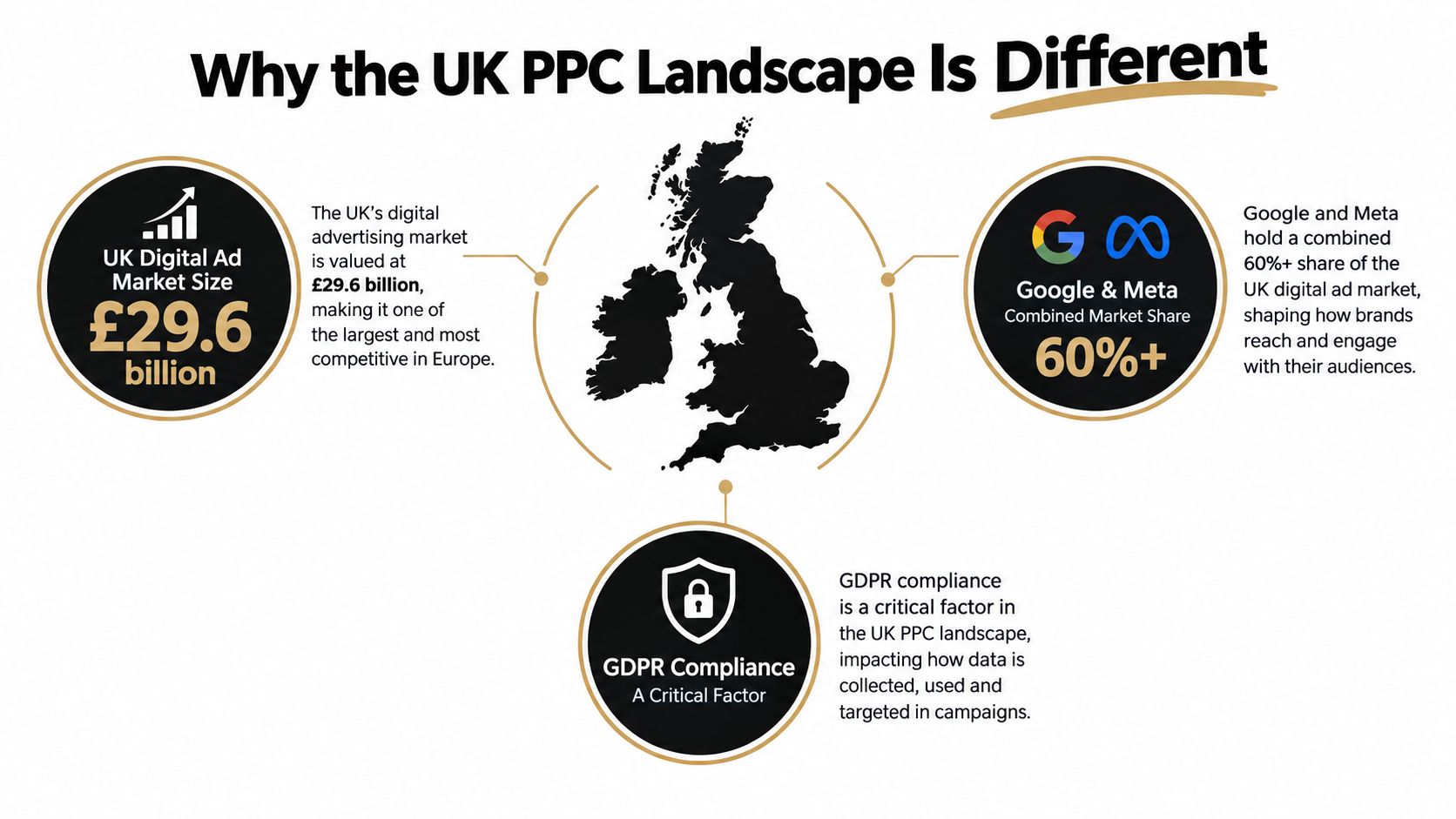
Think of PPC like a shop window on a busy high street. You don't pay for everyone who walks past. You pay when someone steps inside. But a profitable shop still needs more than footfall. It needs the right location, a clear display, trained staff, a simple route to checkout, and a way to count what sold.
PPC management works the same way. The click is only the entry point.
The moving parts inside a PPC account
A PPC account looks simple from the outside. Pick keywords, set a budget, write ads. In practice, it behaves more like a system where each part affects the others.
- Keyword strategy: This is how you decide which searches deserve budget. Some terms show research intent, others show urgency, and others attract poor-fit traffic.
- Account structure: Campaigns and ad groups help you control budgets, messaging, match types, geography, and reporting. Weak structure creates blurred data.
- Bidding: You set rules for how aggressively the platform competes in each auction. That can be manual, automated, or a mix depending on signal quality.
- Ad creative: The ad has to match the query and promise a useful next step. Relevance affects click-through and downstream conversion behaviour.
- Landing experience: The page needs to continue the conversation the ad started. If the landing page breaks the intent chain, the click gets wasted.
- Tracking and attribution: You need to know what happened after the click, not just that the click happened.
- Optimization: This is the ongoing work of pausing waste, reallocating budget, refining targeting, and improving conversion paths.
Practical rule: If one part of the system is weak, the rest of the account starts lying to you.
A common example is broad matching paired with poor conversion tracking. The campaign may appear to scale because the platform sees more conversion events, but if those events are duplicates, low-value actions, or incomplete signals, bidding can drift toward the wrong audience.
Management is a loop, not a setup task
Many teams get confused. They think PPC management means building campaigns well once. It doesn't. It means running a repeatable loop:
- Measure what's happening
- Analyze why it's happening
- Optimize the controllable inputs
- Report in a way that informs the next decision
That's why specialist PPC work often overlaps with landing page design, analytics, CRM definitions, and feed quality. Search and shopping campaigns don't operate in isolation from the rest of digital marketing.
For a broader view of how search engine marketing fits into digital transformation work, this SEM and search engine marketing service overview is a useful reference point.
What good management looks like in practice
A well-run PPC account usually shows a few operational habits:
Search terms are reviewed commercially
Not every relevant search is a profitable search. A campaign manager has to separate curiosity from purchase intent, and then decide whether to exclude, isolate, or scale that traffic.
Budgets follow intent bands
High-intent campaigns shouldn't compete with awareness campaigns for the same budget pot. When teams blend them together, average CPC and average conversion rate stop telling a useful story.
Reporting answers business questions
A founder doesn't need fifty charts. They need clear answers to questions like:
- Are we buying qualified demand or low-fit traffic?
- Which campaigns support pipeline versus just leads?
- Where is the account limited by tracking, landing pages, or budget?
- What should change next month?
Testing is structured
Useful PPC testing isn't random button clicking. It starts with a hypothesis, such as whether a tighter landing page message will improve form quality, then measures the result against a defined business outcome.
The important shift is this. PPC management UK isn't the art of lowering CPC at all costs. It's the practice of directing spend toward measurable intent and improving the quality of the signals that guide optimization.
Why the UK PPC Landscape Is Different
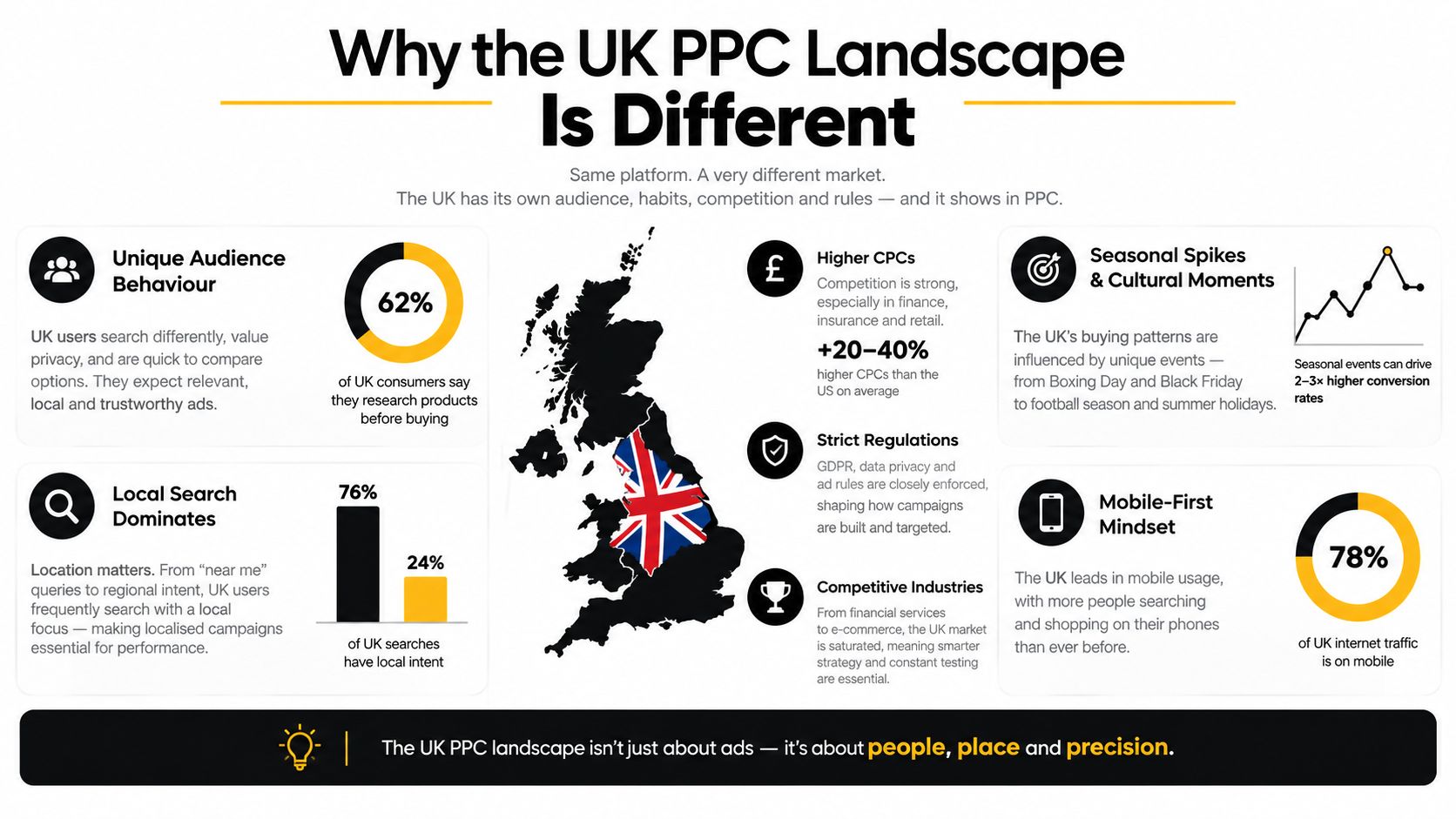
Google controls the vast majority of UK search activity, and that concentration changes how PPC should be managed. In the UK, performance is shaped less by finding clever bidding tricks and more by working inside one dominant platform while protecting measurement quality in a stricter privacy environment.
Google concentration shapes the operating model
A UK PPC account often behaves less like a multi-exchange media buy and more like a business built around one large trading venue. That has advantages. Processes are familiar, campaign types are mature, and teams can build repeatable workflows. It also creates a risk. If Google becomes the default answer to every performance question, teams can overlook the parts of the system Google cannot fix for them, such as CRM quality, consent design, or weak landing pages.
That concentration affects day-to-day management in a few practical ways:
- Tools and habits form around Google first: Reporting, tagging, and bidding decisions usually start there.
- Skill depth can become narrow: A team may know Google Ads in detail but have less experience pressure-testing strategy outside that environment.
- Automation carries more weight: If the platform receives poor conversion signals, its bidding systems still optimize. They just optimize in the wrong direction.
The last point matters more than it sounds. Smart bidding works like sat nav with a partial map. It can still choose a route, but if key roads are missing, the route quality drops.
UK PPC is judged like an investment channel
In a mature market, paid search is rarely treated as a small test budget for long. Founders, finance teams, and heads of marketing usually want to know what spend is producing in pipeline, revenue, or margin terms.
That raises the standard for account management.
Forecasting has to connect media spend to commercial outcomes. Account structure has to stay clean enough that reports still mean something a month later. Teams also need close coordination with analytics, CRM, and web development, because many UK PPC problems start outside the ad platform itself.
A bidding issue can hurt efficiency. A broken form tracking setup can distort every decision in the account.
Privacy rules reduce measurement clarity
This is another reason UK PPC works differently. Privacy controls affect what can be tracked, matched, and attributed, which means reported performance is often less complete than actual business performance.
For UK advertisers, the practical question is not only which keywords to buy. It is whether consent handling, tagging, first-party data capture, and CRM feedback are good enough to give ad platforms reliable optimisation signals. The Information Commissioner's Office explains that organisations using cookies and similar tracking technologies must meet UK consent requirements and give people clear choices in its guidance on cookies and similar technologies.
That changes how strong PPC management is defined:
- Attribution is less complete: Some real conversions will not appear in platform reports.
- Automation is only as good as the inputs: Weak consented data leads to weaker bidding decisions.
- First-party data becomes more valuable: Offline conversion imports, CRM stages, and qualified lead signals help correct what browser-level tracking misses.
- Reporting needs two views: one for platform-reported conversions, and one for sales-confirmed outcomes.
Good UK PPC management is really measurement design plus media buying
Many articles reduce PPC to bids, ads, and CPCs. Those still matter, but they are only one part of the job in the UK market.
A better way to view it is this. Media buying gets you into the auction. Measurement design determines whether the platform learns from the right outcomes. First-party data helps close the gap between a click and a sale. If any one of those parts is weak, return on ad spend can look worse than reality, or look better than reality for a while before budget is wasted.
The teams that perform well in the UK usually do four things consistently. They separate intent properly, protect tracking quality, feed back real business outcomes, and explain results with honesty when attribution is incomplete. That is why UK PPC differs. The hard part is no longer only buying the click. It is building a system that can still judge the click properly.
How PPC Geeks Can Help
PPC Geeks suits a specific type of business need. The fit is strongest when paid acquisition is already important, but the team needs sharper execution, cleaner measurement, and faster account management than a generalist setup usually provides.
Their focus is pay-per-click management across Google Ads, Microsoft Ads, Facebook, and Amazon. In practice, that means one PPC-focused team handling audits, onboarding, campaign builds, conversion tracking, feed optimisation, reporting, and ongoing account changes. Their UK PPC agency page is the clearest place to judge whether that operating model matches your needs.
That matters in the UK market because PPC performance is rarely decided by bids alone.
Google still takes most of the search demand, while consent rules and browser restrictions make conversion signals less complete. A specialist PPC team can help only if it understands that reality and builds around it. The useful test is simple: do they just manage ads, or do they improve the measurement system the ads depend on? The second approach usually produces better decisions because bidding works like a thermostat. If the temperature reading is wrong, the system keeps adjusting in the wrong direction.
Where a specialist PPC agency fits well
A specialist setup tends to work best in a few cases:
- You need more depth in paid media: If Google Ads, Shopping, or remarketing already drives meaningful revenue or leads, a specialist can usually find waste, restructure intent, and tighten execution faster than a broad agency team.
- Your tracking is affecting optimisation: Conversion setup problems are not reporting issues alone. They change how smart bidding learns. Agencies that work in PPC every day often spot missing signals, weak attribution design, and poor lead-quality feedback early.
- You want one owner for channel performance: A focused PPC partner can work well when the business mainly needs tighter control over acquisition efficiency, search query quality, feed health, and budget allocation.
Where to be cautious
A PPC specialist is not the right answer to every growth problem.
If the constraint sits on the website, inside the CRM, or in sales follow-up, paid media management will only fix part of the system. Good click costs cannot rescue a weak landing page or slow lead handling. In that situation, choose a broader delivery model and bring the PPC specialist in as a channel lead.
The right way to judge PPC Geeks is by operational fit, not agency claims. If you need hands-on PPC specialists, clear reporting, regular optimisation, and support across search, shopping, remarketing, and platform execution, they are a strong option. If your bottleneck sits outside paid media, choose a broader delivery model and use the PPC specialist to support that wider programme.
Pricing Models ROI Expectations and Click Economics
The most expensive PPC setup isn't always the one with the highest CPC. It's the one where pricing, incentives, and measurement are misaligned.
That matters because many businesses ask, "What does PPC cost?" when the better question is, "What commercial model gives us the right behaviour?" Agency pricing influences priorities. So does click economics.
Why averages mislead
UK PPC accounts can vary sharply by business model, query intent, and industry. One UK benchmark set reports average Search CPC at £1.95 with a 4.7% CTR and 4.4% conversion rate, while another UK ecommerce benchmark reports average CPC at £1.28 and ROAS at 4.0x, as summarised in these UK Google Ads benchmark figures. The useful lesson isn't which number is "right." It's that blended averages hide intent differences.
A founder running lead generation for legal or emergency services shouldn't judge performance using ecommerce-style benchmarks. An ecommerce manager shouldn't expect a branded search campaign and a prospecting shopping campaign to behave the same way.
UK PPC pricing models compared
| Pricing Model | How It Works | Best For | Watch Out For |
|---|---|---|---|
| Flat retainer | You pay a fixed monthly management fee regardless of spend | Stable accounts with predictable workloads | Incentive can weaken if account complexity rises sharply |
| Percentage of spend | Fee scales with media budget | Businesses increasing spend and wanting simple alignment | More spend doesn't always mean more strategic work |
| Performance-based | Agency compensation ties partly to agreed outcomes | Mature setups with trusted tracking and clear commercial definitions | Weak attribution can create disputes or perverse incentives |
| Hybrid | Combines retainer with spend-based or outcome-based elements | Businesses that want baseline service plus growth alignment | Contracts can become hard to compare if terms aren't clear |
Matching model to business reality
A small account with simple geography and a narrow product range often benefits from a flat fee because workload doesn't always rise linearly with spend. A more complex ecommerce business with feeds, seasonal shifts, multiple campaigns, and frequent merchandising changes may prefer a hybrid arrangement because it reflects both baseline work and scaling effort.
Performance-led commercial models sound attractive, but they're only as fair as the measurement setup behind them. If lead quality is disputed or CRM outcomes never sync back to the ad platform, "pay for results" becomes hard to define.
If you can't define a trusted conversion event, you can't build a sensible performance fee around it.
Click economics by intent matter more than a blended CPC
The same logic applies inside the account. A useful UK service benchmark shows average CPC ranges of £4.50 to £8.50 for emergency electricians versus £2.40 to £3.80 for general electricians, with conversion rates of 12.0% to 22.0% versus 8.5% to 14.0%, and CPL ranges of £38 to £78 versus £24 to £58, according to this UK Google Ads benchmark report.
That tells you something important. Expensive clicks aren't automatically bad clicks.
An emergency search can cost more because the intent is stronger and the lead value is higher. If a manager fixates on lowering CPC without considering conversion rate and downstream lead quality, they can cut off the most commercially valuable traffic.
A simple decision matrix for ROI expectations
When you're setting expectations, ask these questions in order:
- What is the value of a qualified lead or sale?
- Which search intents produce that value most consistently?
- Can tracking distinguish high-value outcomes from low-value ones?
- Does the pricing model encourage useful optimization behaviour?
If the answer to question three is no, be careful with automated bidding and performance-led contracts. If the answer to question one is unclear, don't let anyone promise neat ROI projections based on CPC alone.
In UK PPC management, pricing and ROI expectations make sense only when they reflect intent segmentation, conversion quality, and measurement confidence.
Measuring Performance and Reporting That Drives Decisions
A large share of paid media waste starts after the click, in measurement. The campaign may be fine. The reporting setup may be the part that fails.
That distinction matters in UK PPC because Google still dominates search demand, while privacy controls reduce what platforms can observe directly. In that situation, ROI depends less on shaving a few pence off CPC and more on whether your tracking, consent setup, and first-party data give bidding systems enough truth to work with.
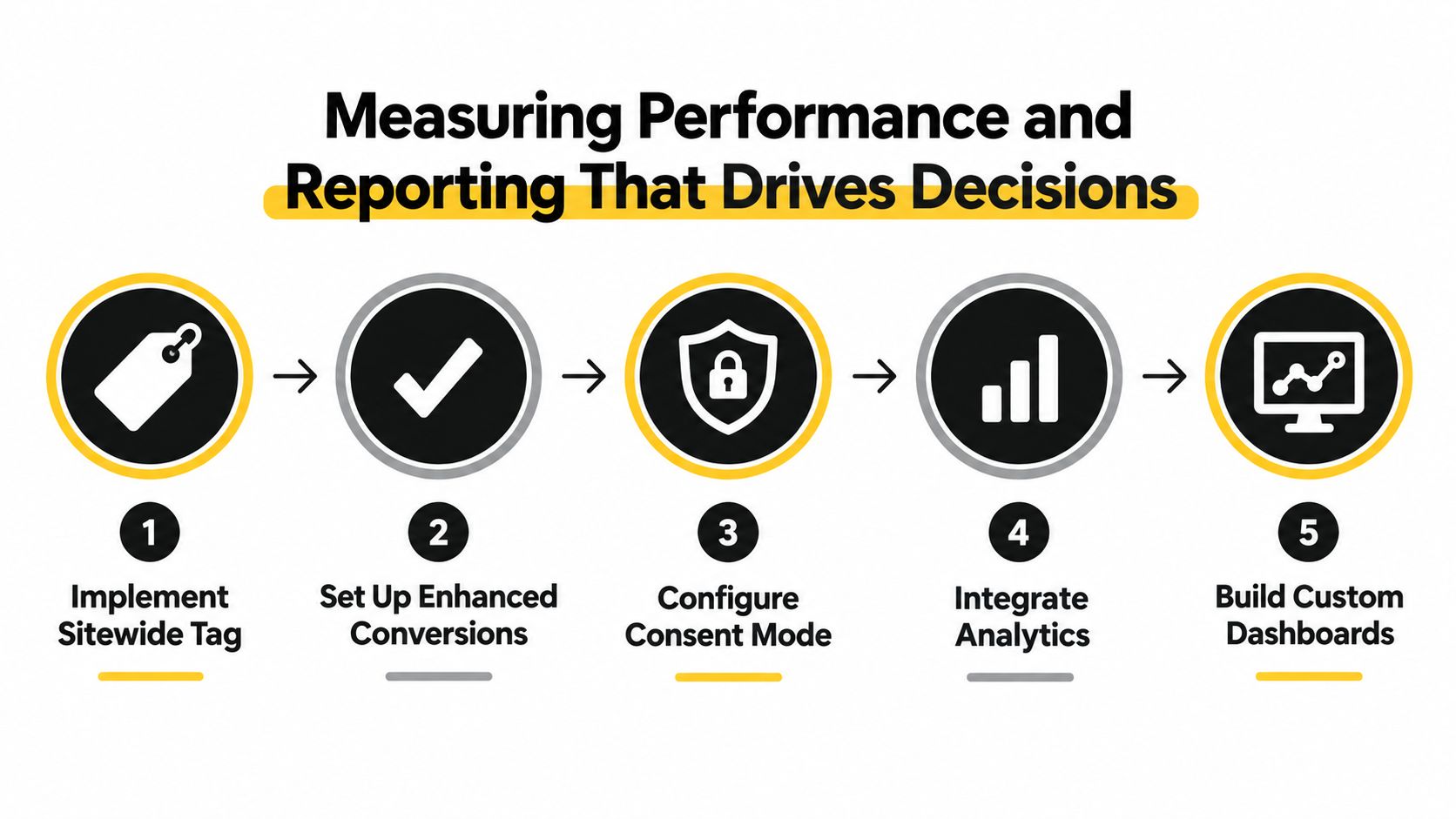
The modern measurement stack
Treat measurement like the foundation under a house. If the foundation shifts, the rooms upstairs may still look tidy for a while, but the structure is no longer trustworthy.
Sitewide tagging
Tagging is the base layer. A tag that fires on some pages, misses key form steps, or duplicates conversions creates reporting noise that looks like performance insight. Many teams stop at "the tag is installed." The key question is whether it records the right event, at the right moment, for every meaningful action.
Enhanced conversions
Enhanced conversions help recover some measurement quality by using first-party data in a privacy-aware format. In practical terms, this helps platforms connect more real outcomes back to ad interactions. That matters in lead generation accounts where a standard thank-you-page signal often misses part of the picture.
Consent Mode
Consent Mode shapes what can be observed directly and what gets modelled. If the banner logic is broken, delayed, or disconnected from your tags, reported conversion drops can reflect measurement loss rather than weaker demand. Google's Consent Mode documentation explains how consent signals affect measurement and modelling.
Analytics integration
Analytics adds the behaviour between click and conversion. You can see where users hesitate, which landing pages leak demand, and how mobile traffic behaves compared with desktop. For a refresher on the reporting shift from Universal Analytics, this guide to Google Analytics 4 is a useful primer.
Which KPIs help, and where they can mislead
Good PPC reporting uses platform metrics, but it does not stop at platform metrics.
- CTR shows whether the ad attracts attention from the searches you entered. It does not show whether those clicks turn into useful revenue.
- CPC shows auction cost. It says nothing about lead quality on its own.
- Conversion rate helps only when conversion definitions are clean. A newsletter signup and a sales-qualified lead should not sit in the same bucket.
- CPL is better for lead generation than CPC, but it still misses what happens after the form fill.
- ROAS can guide ecommerce decisions if revenue tracking is accurate, timely, and tied to real margin logic.
- True ROI needs business data outside the ad platform, such as CRM stage progression, sales acceptance, close rate, and retained value.
The trap is simple. Teams report what is easy to export, then optimise toward what is easy to export.
Reporting for action
A report should help a founder or marketing manager make a decision that week. If it cannot answer "what should we change next?" it is a dashboard, not a management tool.
A practical reporting structure is to review performance through four questions:
| Question | What to inspect | Likely action |
|---|---|---|
| Are we attracting the right demand? | Search terms, audience signals, query intent | Add negatives, separate campaigns, refine targeting |
| Are we converting that demand well? | Landing pages, forms, product pages, path drop-off | Improve UX, tighten message match, reduce friction |
| Are we measuring outcomes reliably? | Tag firing, consent behaviour, CRM matchbacks | Fix tracking, add enhanced conversions, review attribution |
| Is automation learning from good signals? | Conversion definitions, offline quality feedback | Change bidding inputs, import better outcome data |
Notice the order. Measurement sits before automation decisions for a reason. Smart bidding works like a sat nav with partial road data. It can still help, but if the map is wrong, it will guide you with confidence in the wrong direction.
Automation is only as good as the signal
UK ad spend remains high, and privacy-related browser and measurement changes are still active, as outlined in this Privacy Sandbox progress report. The practical consequence is straightforward. As more accounts rely on automation, weak first-party data makes bidding less trustworthy.
Automated bidding is not the problem. Poor conversion inputs are the problem.
Ask three hard questions:
- Are we optimising for real business outcomes, or for proxy actions that happen to be easy to track?
- Does the platform receive enough first-party signal to tell a poor lead from a valuable one?
- Which parts of reported performance are observed directly, and which are modelled?
Strong reporting does not pretend uncertainty has gone away. It shows where the blind spots are, separates measurement issues from market issues, and helps the team make better budget decisions anyway.
Choosing Between Agency In House and Hybrid PPC Management
The best operating model is the one that matches your bottleneck. Not your aspiration, your actual bottleneck.
Some businesses assume in-house means more control and agency means more expertise. That can be true. It can also be false. A brilliant in-house lead can outperform a mediocre agency, and a strong agency can outperform a fragmented internal team where no one owns tracking, landing pages, and media together.
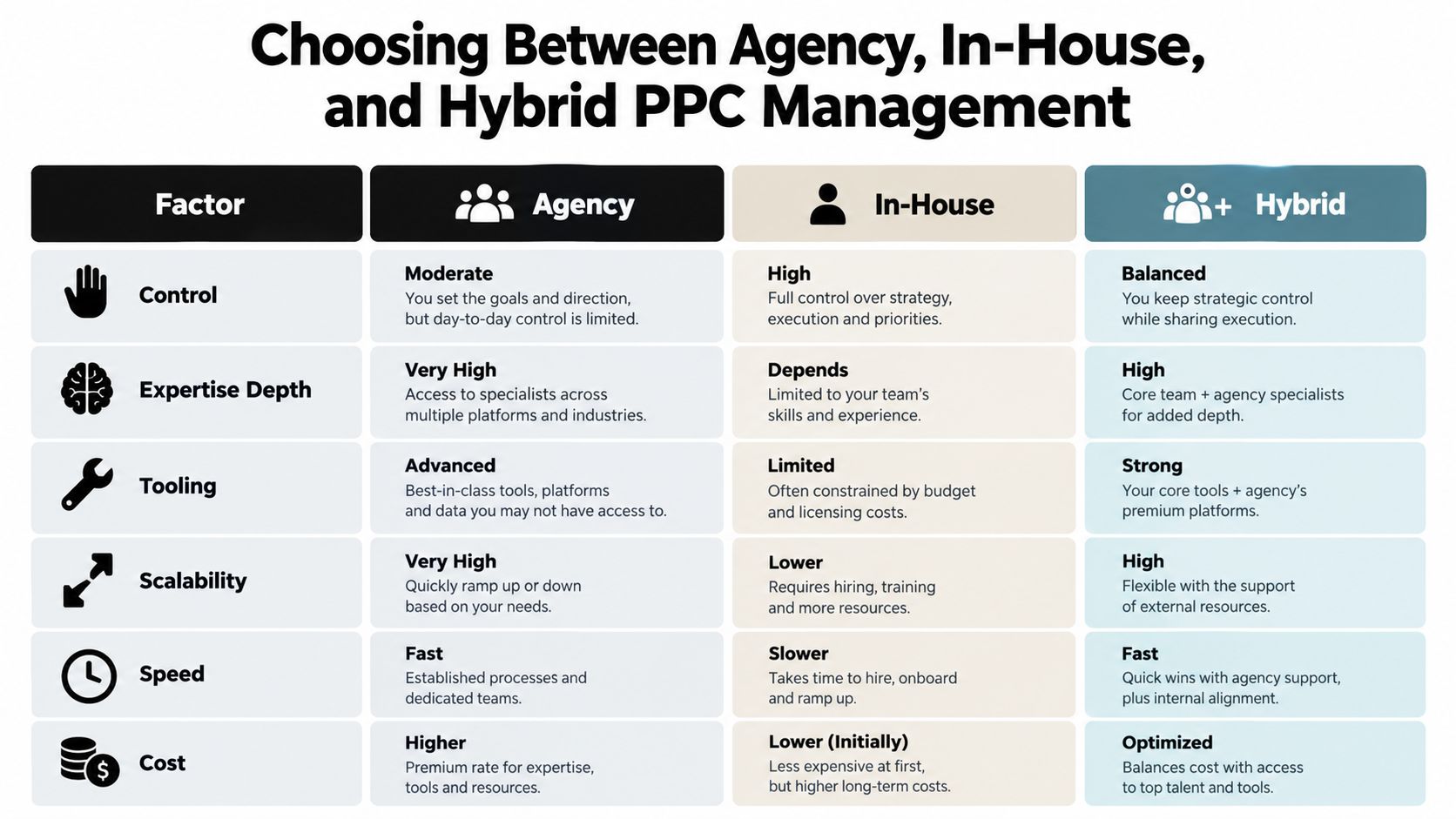
How the three models differ in practice
Agency
An agency model usually works best when the company needs specialist execution, broader platform exposure, and a repeatable optimization process. Agencies often bring established workflows, tooling familiarity, and external pattern recognition from many accounts.
The trade-off is distance from the business. If the agency doesn't receive product insight, sales feedback, or CRM outcomes quickly, performance can plateau.
In-house
In-house management tends to work well when PPC is central to revenue and the business can support dedicated expertise. The big advantage is proximity. Internal teams can coordinate messaging, promotions, stock realities, and commercial priorities faster.
The risk is narrow capacity. One strong PPC manager may still struggle to cover strategy, feeds, tracking, creative testing, analytics, and stakeholder reporting alone.
Hybrid
Hybrid models are often the most realistic for growing businesses. Internal teams keep strategic ownership and business context, while an external partner supports specialist execution, audits, or platform depth.
This approach tends to work best when responsibilities are explicit. If both sides assume the other owns tracking, landing page testing, or reporting design, gaps appear quickly.
Decision criteria that matter more than preference
Instead of asking which model is "better," ask which model fits these conditions:
- Control needs: Do you need day-to-day ownership or just strategic visibility?
- Expertise depth: Is your challenge media execution, analytics, feed management, or cross-channel coordination?
- Speed requirements: Can your current team launch and iterate fast enough?
- Scale complexity: Are you managing one market, multiple markets, or multiple business units?
- Data maturity: Can your team maintain the measurement stack properly?
If you're weighing agency selection criteria more broadly, this guide on things to consider when choosing a digital agency gives a helpful framework.
A practical matching framework
A simple way to consider it:
- Use in-house when PPC is strategically central and you already have strong analytics and web support.
- Use agency when you need specialist speed, account recovery, or hands-on channel expertise.
- Use hybrid when the business has internal ownership but lacks full execution depth.
The wrong model isn't the one with the highest fee. It's the one where accountability for results gets blurred.
Your Checklist for Selecting a PPC Provider and Next Steps with Reklam5
Choosing a PPC provider gets easier when you stop asking who sounds confident and start asking who can run the whole performance system properly.
A provider should be able to discuss search intent, account structure, tracking, consent, landing experience, reporting logic, and business outcomes in one conversation. If they only want to talk about ads, that's a warning sign.
The shortlist checklist
Use this as a working screen before you sign anything.
Strategy and structure
Ask how they segment campaigns by intent, geography, product line, or service category. A serious provider should explain how structure supports budget control and reporting clarity, not just say they'll "optimize continuously."
Measurement readiness
Ask what they need in place for sitewide tagging, enhanced conversions, consent-aware reporting, and analytics integration. If they treat tracking as a setup detail, they're underestimating what drives ROI.
Reporting quality
Request sample reports and judge them by usefulness, not volume. You want reports that explain what changed, why it changed, and what action follows. You don't need a PDF full of screenshots from ad platforms.
Commercial alignment
Clarify how success is defined. Is it leads, qualified leads, pipeline, revenue, or blended business outcomes? If those definitions are vague, pricing and accountability will become vague too.
Channel and platform fit
Check whether they have practical experience with the platforms your mix requires. Search, Shopping, Microsoft Ads, paid social support, remarketing, and feed-based campaigns all demand slightly different operating habits.
Working model
Confirm who owns what. That includes landing pages, tracking fixes, feed updates, CRM feedback loops, and stakeholder communication.
A PPC provider should improve your decision-making, not just your dashboard volume.
Where Reklam5 can fit
If your need goes beyond ad account management into multi-market execution, UX, analytics, and platform coordination, Reklam5 is one option to consider. Its performance advertising work sits alongside SEO, UX, analytics, and CIQRA-based digital infrastructure, which can be useful when PPC performance depends on landing page architecture, ecommerce systems, or broader measurement design rather than bidding alone.
That kind of model tends to suit mid-market and enterprise teams that don't just need campaign management. They need coordination across media, website experience, analytics, and implementation.
A practical next 30 days
If you're trying to improve PPC management in the UK, this is a sensible order of operations:
Audit conversion definitions Check whether the platform is optimizing toward meaningful business outcomes or shallow proxy actions.
Review consent and tagging Verify that measurement is stable enough to support bidding and reporting decisions.
Split campaigns by intent Separate high-intent demand capture from broader prospecting so budgets and KPIs stop fighting each other.
Inspect landing page continuity Make sure the message in the ad matches the page and the page supports the next action clearly.
Choose the right operating model Decide whether your bottleneck is channel expertise, internal capacity, analytics, or cross-functional coordination.
Ask providers harder questions Don't just ask what they charge. Ask how they measure, what they optimize for, and how they handle incomplete data.
The businesses that do PPC well in the UK usually aren't the ones with the loudest tactics. They're the ones that treat paid search as a managed commercial system. Budget matters. Bids matter. Creative matters.
But when the market is Google-dominated and privacy-constrained, measurement design and first-party data quality usually decide whether PPC becomes efficient growth or expensive noise.
Copyright 2026 - Reklam5: Dijital Ajans ·  tarafından desteklenmektedir
tarafından desteklenmektedir