UGC Video Ads That Turn Creative Into Measurable Growth
22 OCTOBER 2026
Is a creator video that's racking up views creating profitable demand, or is it just buying inexpensive attention you'd have earned anyway? That's the question worth answering before you commission another batch.
Table of Contents
- Why UGC Video Ads Need More Than Views
- Understand What Makes a Video Ad UGC
- Choose UGC Video Ad Formats for Buyer Questions
- Place UGC Within Your Paid Campaign Strategy
- How Knowlify Can Help
- Build UGC Creative That Earns Attention and Trust
- Run a Rights-Cleared UGC Production Workflow
- Measure UGC Video Ads Beyond Platform ROAS
- Make Your Next UGC Campaign Ready to Learn
Why UGC Video Ads Need More Than Views
Consider a hypothetical scenario. A creator films a handheld clip of your product on her kitchen counter. It holds attention, comments look positive, and the view cost looks cheap. Yet your landing page conversion rate doesn't move, returns tick up, and finance asks what the video earned.
That gap is common because UGC video ads are often judged like organic content. They're not. Once you pay for distribution, pay a creator, and license usage rights, the asset has to justify media spend plus production cost against contribution margin, not just engagement.
Neither rough filming nor a recognizable face guarantees that outcome. A polished brand spot can answer a buyer question clearly, and a casual clip can ramble past the point where a viewer leaves. What matters is whether the video gives a specific buyer a reason to act, reaches that buyer at the right funnel stage, and can be measured against a commercial result.
The decisions ahead are practical. What counts as UGC, which format answers which buyer question, where the asset runs, how you produce and clear it, and how you prove it created value.
Understand What Makes a Video Ad UGC
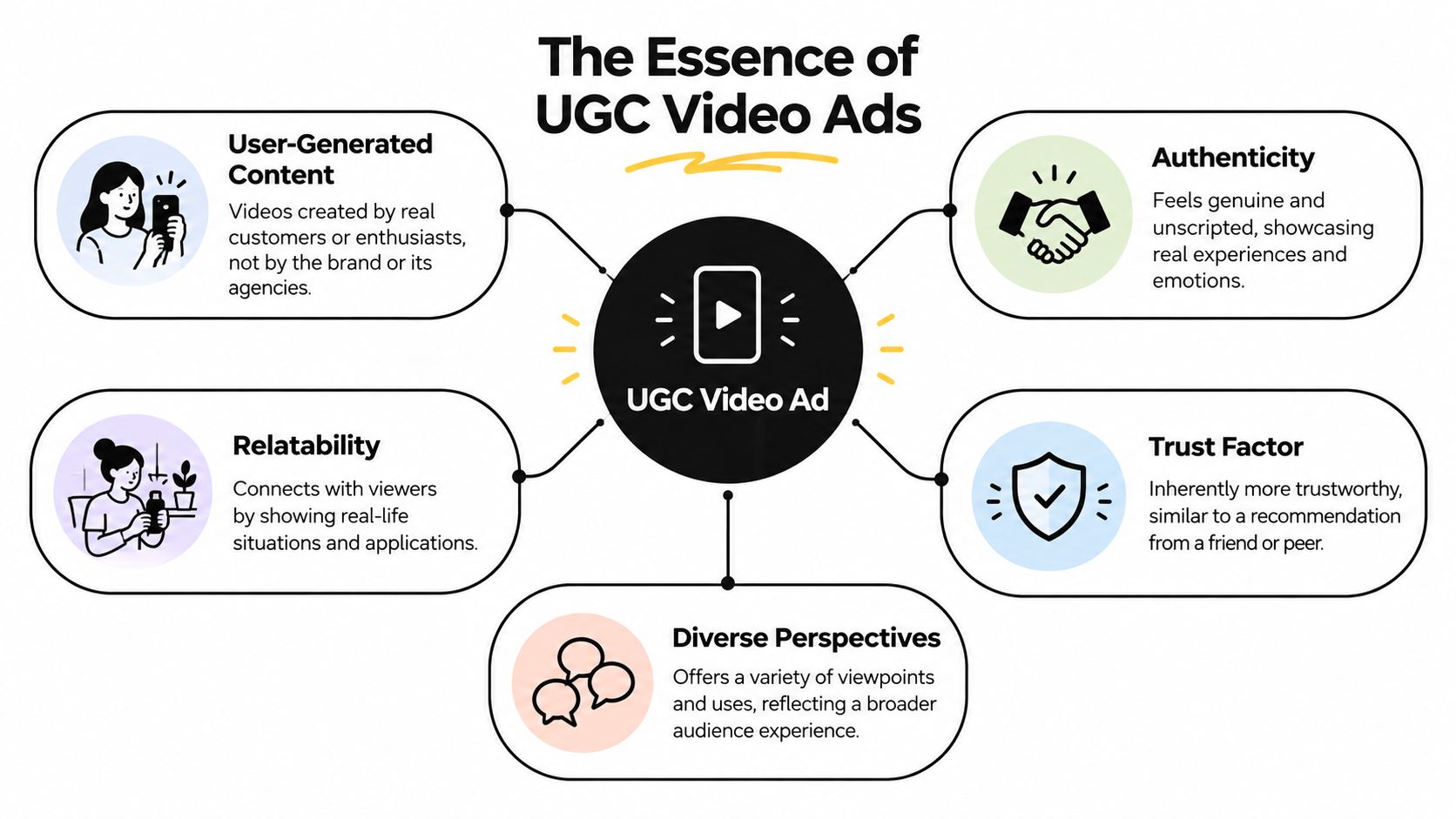
Think of a friend recommending shoes over coffee. The recommendation itself is just a conversation. It becomes advertising when the shoe brand gets permission to use a recording of it and pays to put it in front of strangers. UGC video ads work the same way. The content starts person-led, and the brand turns it into paid media.
Four Origins, Four Different Claims
- Genuine customer content: A buyer posts a review or try-on unprompted. You still need permission before running it as an ad.
- Commissioned creator content: You hire someone to film in a customer-led style. The person may have tested the product, but the video was made for your campaign.
- Influencer distribution: You're buying access to the creator's audience, not just a file. That buying logic differs from commissioning an asset, a distinction explored in this comparison of influencer marketing and performance marketing.
- Synthetic avatars: An AI presenter mimics the style. That's UGC-style advertising, not customer testimony, and it shouldn't be presented as lived experience.
Customer-like presentation is not proof of a real customer experience.
Why does the distinction matter commercially? Because the mechanism isn't shaky camera work. A 2024 peer-reviewed study on UGC, usefulness, trust, and purchase intention reported significant relationships among those four variables. Purchase intention isn't observed sales, and the study doesn't establish a universal paid-ad lift. It does point you toward the right production goal, which is a useful demonstration delivered by a credible source.
Choose UGC Video Ad Formats for Buyer Questions
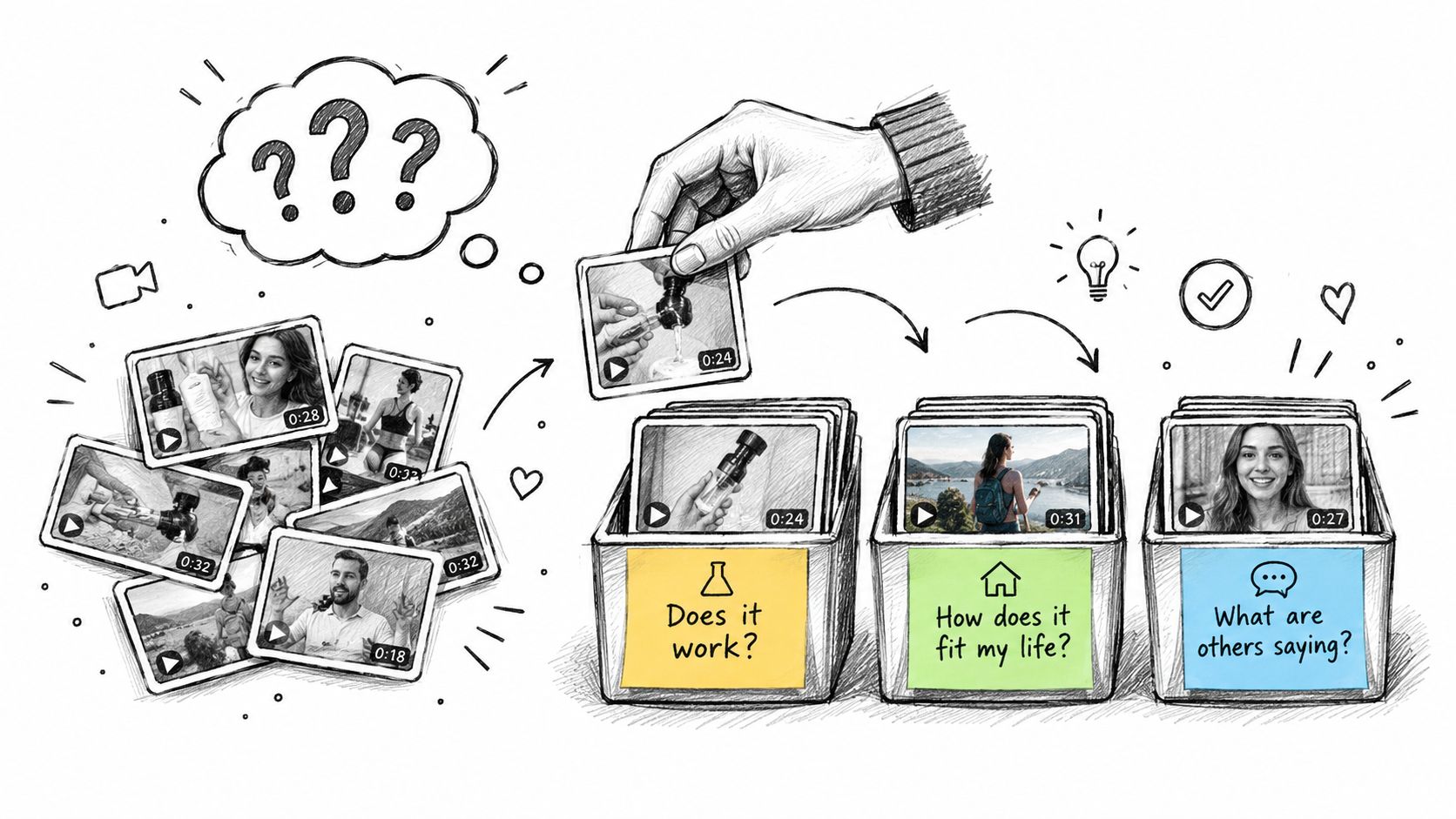
Start with the question a buyer can't answer from your product page. Then pick the format that supplies that missing evidence.
An Apparel Storyboard
A hypothetical running legging addresses one doubt, will it stay up during a run?
- Opening line: "I stopped wearing these mid-run to pull them up."
- Visible evidence: The creator jogs, bends, and sits on camera. You see fit and movement instead of hearing a claim about stretch fabric.
- Next action: Check your size against the fit guide on the product page.
That's a demonstration. Swap the opening to a hesitation, "I almost didn't order because sizing looked inconsistent," and the same footage becomes objection handling.
A B2B Software Walkthrough
A hypothetical invoicing tool faces a different fear, implementation time. A finance manager records a screen walkthrough using a demo workspace, imports a sample file, and issues a test invoice. No customer data appears. The close offers a sandbox trial rather than a sales call, because the viewer still needs to test fit.
Other formats fill narrower gaps. Problem-solution stories show the before state, the product in use, and the after state in sequence. Permissioned testimonials work when a real customer's outcome is specific and substantiated. Unboxing answers size, packaging, and what's-included questions, but it tells a buyer almost nothing about whether a complex product performs, so it's rarely enough on its own for considered purchases.
Choosing among these is worth testing rather than assuming. In a Realeyes analysis of 11 brands, TikTok UGC videos scored 21% higher than Facebook ads and 68% higher than conventional ads on a composite of attention, retention, and emotional response. That's a reason to test creator-native formats, not a conversion benchmark, and it doesn't mean every format above performs equally well.
Place UGC Within Your Paid Campaign Strategy
Distribution decides what a good video can accomplish. Match the asset to funnel intent first, then worry about account mechanics.
Prospecting needs problem recognition. A clip that names a familiar frustration introduces the category to people who've never searched for you. Consideration needs demonstrations and comparisons, because the buyer is weighing alternatives. Retargeting needs objection handling aimed at people who viewed a product page and left, provided your audience size and consent setup support it.
Whose Account Runs It
You can run creator footage from your brand account as a standard ad, or use permission-based formats such as Meta Partnership Ads and TikTok Spark Ads, which publish through the creator's handle with their authorization. The creator handle can change how the ad reads in feed. It doesn't replace targeting, budget control, or optimization, and the creator's organic following isn't a targeting strategy.
Platform research supports testing the native route without overselling it. A 2021 Mindlab study commissioned for TikTok tested 17 advertisements through 5,000 interviews across five European markets in a simulated TikTok environment. Creator-partnered ads achieved a 65% higher two-second view rate and a 91% higher six-second view rate than comparable ads without creator partnerships. Those are attention gains in a simulated, platform-sponsored setting, not proven sales gains.
Adapt each placement natively instead of cropping one master file, and keep the landing page promise identical to the video's claim. Coordinate with search too, since social often creates demand that search later captures. This industry-by-industry comparison of Google Ads and Meta Ads helps frame which channel should own which intent. There's no universal budget split worth copying.
How Knowlify Can Help
Some teams don't lack ideas. They lack production throughput, so one winning creator concept never becomes a testable set of variants. That's a capacity problem, and it's where a managed production partner can fit.
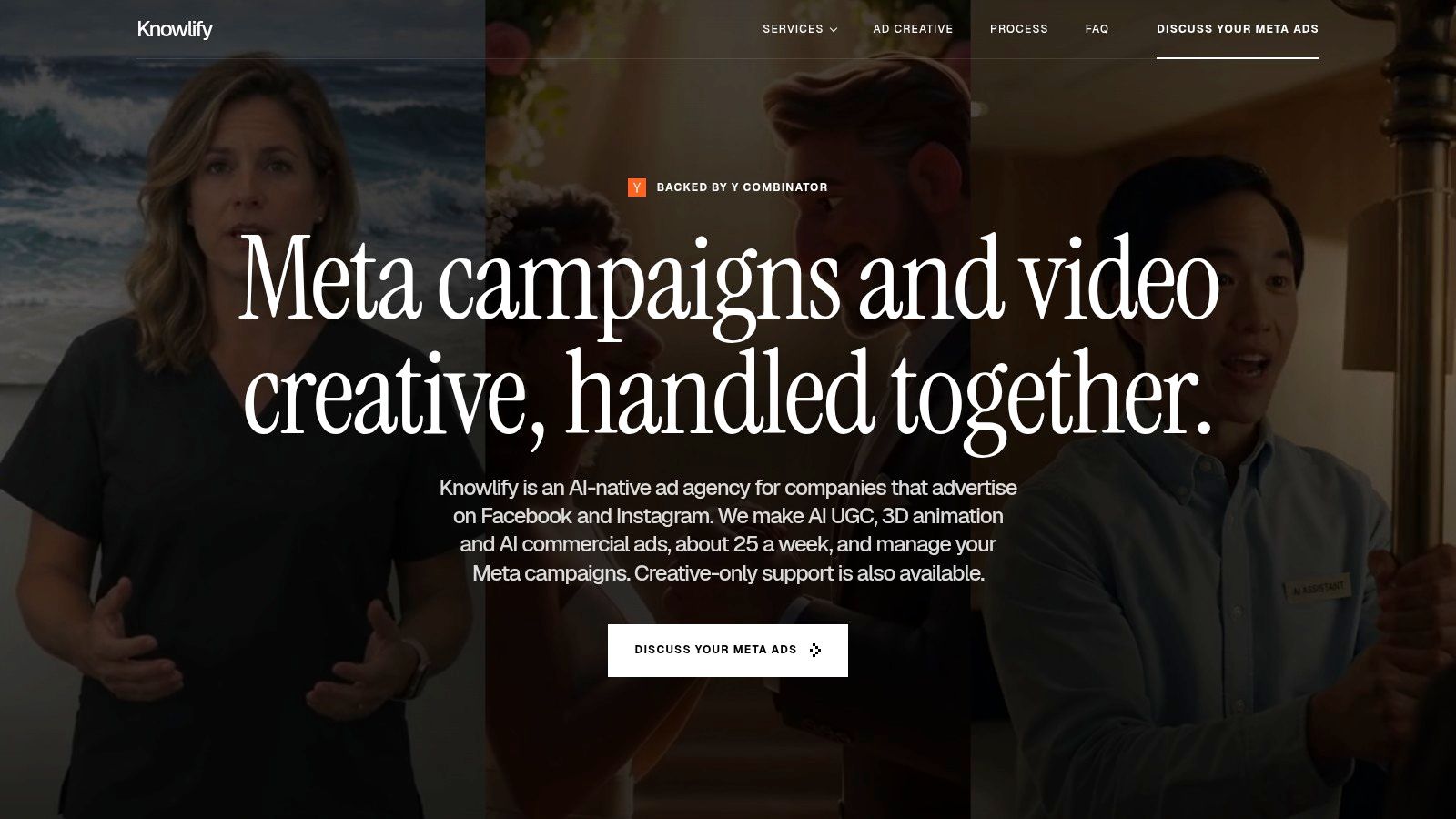
Knowlify is a done-for-you AI video advertising agency for B2B and B2C companies running paid social. It produces AI UGC ads, Pixar-style character animation ads, and AI commercials, handling concepts, scripts, production, editing, and sound. Every finished ad receives a human quality check before delivery, which matters because synthetic presenters raise the disclosure and consent questions covered later in this guide.
How an Engagement Runs
- Kickoff: A 20-minute call covers your product, audience, goals, and brand assets.
- Creative direction: You receive direction for approval within 48 hours.
- First batch: Finished ads arrive five days after the call, with monthly plans adding new batches weekly at about 25 finished ads per week.
- Iteration: Campaign results inform the next round of creative.
You can buy creative production only, or combine it with end-to-end Facebook and Instagram campaign management. Media spend stays separate, and you retain your ad accounts and every finished ad, with responsibilities and pricing agreed in the proposal. Knowlify is backed by Y Combinator, Summer 2025.
This route suits teams that need volume and testing speed but don't want to build an internal studio. It suits you less if your product requires a real customer's documented experience, because AI UGC is UGC-style and can't substitute for genuine testimony. Review examples and booking details on the Knowlify website alongside Knowlify video ad production to judge format fit against your own brief.
Build UGC Creative That Earns Attention and Trust
Native doesn't mean careless, and it doesn't mean faking spontaneity. It means the video earns attention in feed while staying intelligible and honest.
TikTok's creative guidance on hook, body, and close structure identifies the first six seconds as critical and recommends that sequence. Treat that as platform-specific guidance for opening immediately, not a universal six-second rule or a fixed ideal length for every placement.
One Annotated, Illustrative Script
This hypothetical script sells a carry-on bag.
| Beat | Viewer Sees | Creator Says |
|---|---|---|
| Hook | Finished packed bag, zip closing | "Five days of clothes, one carry-on." |
| Demonstration | Bag unpacked item by item, shoe compartment opened | "Shoes go in their own section, so clean clothes stay separate." |
| Close | Bag lifted into an overhead-style space | "See the full packing list before you order." |
The hook leads with the result, so the viewer knows why to stay. The body proves the claim visually instead of asking for trust. The close asks for one action that matches the viewer's stage, reviewing a packing list, rather than stacking "shop now, follow us, and share this" into a single breath.
Weak Versus Strong Wording
Weak wording leans on enthusiasm you can't verify. "This is life-changing, everyone needs one" gives a buyer nothing to evaluate and creates substantiation risk.
Stronger wording stays specific and checkable. "The separate shoe compartment kept my packed shirts away from my trainers" describes an observable product interaction. If the creator has not packed the bag, do not script the line as if they had. Reframe it as a demonstration, "Here's how the shoe compartment separates," and show it.
A useful test: Mute the video. If a viewer can't tell what the product does from the visuals and captions alone, the demonstration isn't carrying its weight.
Creative Review Checklist
- Opening frame: Does the problem, result, or visual proof appear immediately, without clickbait that the body can't repay?
- Product interaction: Is the product handled, worn, installed, or operated on camera?
- Audio and captions: Is speech intelligible, and are captions readable outside platform interface zones?
- Framing: Is vertical framing used where the placement expects it, with key text inside safe areas?
- Claim discipline: Is every benefit substantiated, with no invented experience?
- Single CTA: Does the close ask for exactly one next step?
Run a Rights-Cleared UGC Production Workflow
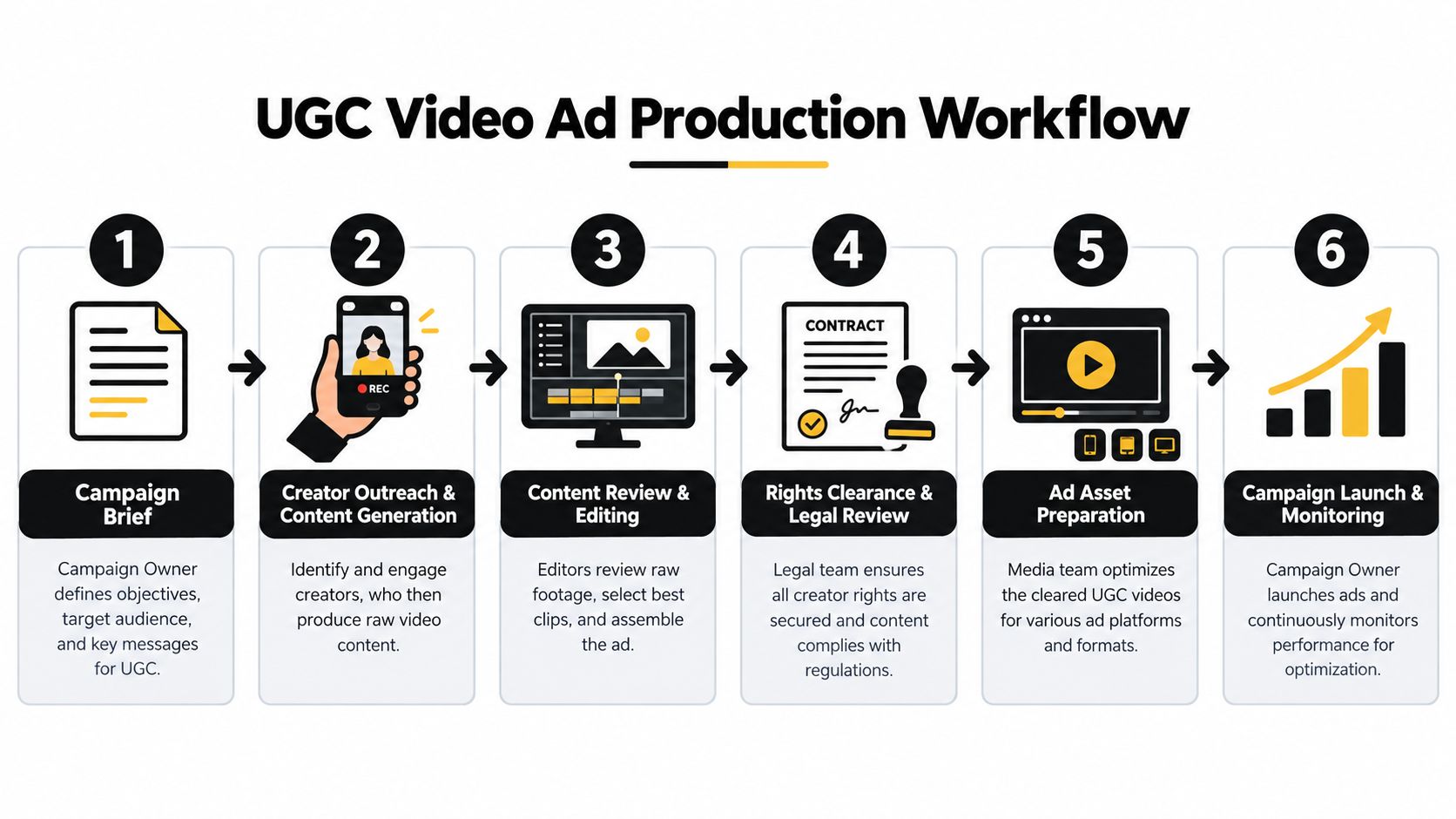
A strong script still fails operationally if usage rights expire mid-campaign or the editor can't find the approved cut. Treat production as a handoff chain, with each owner clearing a specific risk.
The Workflow
- Define the brief. The campaign owner states the business objective, audience objection, offer, deliverables, and approved claims. Creators should not have to guess which benefits legal has cleared.
- Select for fit. Judge creators on product credibility and communication clarity, not follower count alone. A niche tradesperson demonstrating a tool can out-persuade a broad lifestyle creator.
- Agree terms before filming. Set compensation, revision limits, turnaround, and raw-footage delivery in writing.
- Produce and edit. The editor cuts to the hook and returns placement-specific versions, not one master.
- Clear rights and review. Confirm paid usage duration, territories, editing rights, creator-account permissions, music licensing, and likeness consent. There's no universal contract standard, so document what you negotiated.
- Prepare and launch. The media team receives named, versioned, trackable files with rights expiry dates attached.
Disclosure Is Two Separate Decisions
Sponsorship disclosure tells viewers the content is advertising. AI disclosure tells them a face, voice, or demonstration is synthetic. A visible "Ad" label can satisfy the first while saying nothing about the second. Never present a synthetic testimonial as someone's lived experience, regardless of how the label reads.
Market review belongs in the chain too. Localization should change language and cultural references while preserving the tested proposition, and translated captions need their own accuracy check. A claim that's acceptable in one market may need substantiation or rewording in another.
Cost Checklist
- Creator fee: Filming and any reshoots within agreed revisions.
- Usage licensing: Paid media duration, territories, and renewal terms.
- Editing: Cutdowns, captions, and placement adaptations.
- Music and likeness: Licenses and consent documentation.
- Management time: Briefing, review cycles, and asset administration.
If you can't state when an asset's rights expire, you don't have a scalable creative library. You have a folder of liabilities.
Track naming consistently, something like creator, hook, format, market, version, expiry. When a winner emerges, you'll know whether you're legally able to scale it.
Measure UGC Video Ads Beyond Platform ROAS
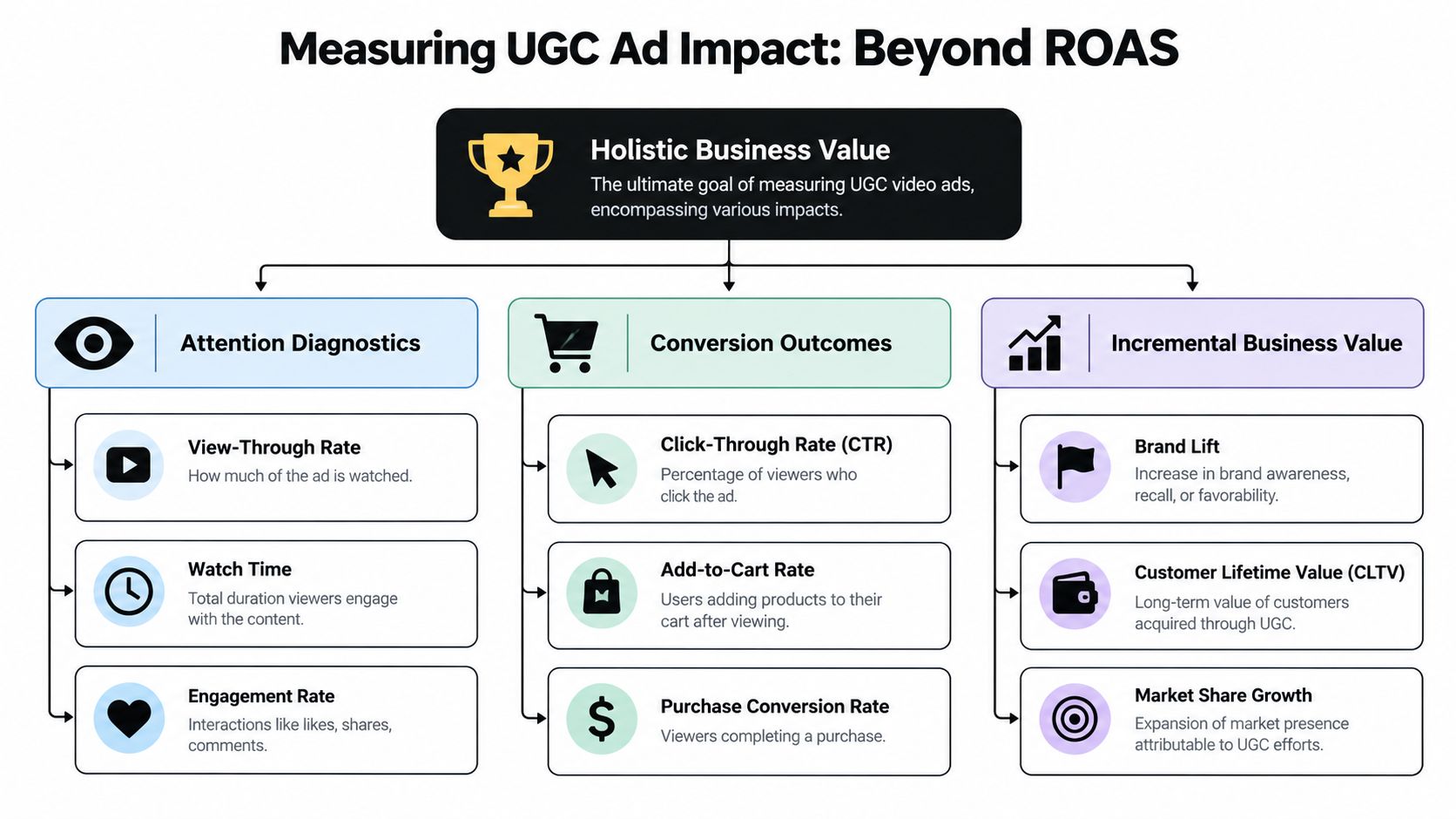
Views tell you where a creative problem lives. They don't tell you whether the asset deserves more budget. Separate three layers and make decisions at the right one.
Layer One, Attention Diagnostics
Retention curves, completion, and early hold show whether the hook and demonstration work. Define the denominator before comparing assets, because platforms count views differently. A view-through rate built on impressions isn't comparable to one built on plays. Weak early hold usually means the opening frame promised too little or the proof arrived too late, which is a creative fix, not a budget fix.
Layer Two, Conversion Outcomes
Click-through rate, landing-page conversion rate, cost per acquisition, and attributed ROAS describe what happened after the view. Read them together. A high click-through rate paired with a weak landing-page conversion rate points at a message mismatch between ad and page. A strong conversion rate with low clicks suggests the proof works but the hook doesn't.
For context on what directional evidence looks like, industry coverage of Meta-reported Partnership Ads tests reports 19% lower CPA and 13% higher CTR on average across roughly 2,400 advertisers. Those figures come through a secondary source summarizing platform-reported results. They don't independently establish incrementality, and they aren't an expected result for your account.
Layer Three, Incremental Business Value
Attribution assigns credit. It doesn't prove the ad caused the sale. A UGC video can post a cheap CPA by converting people who'd have bought through search anyway, or by pulling forward discount-driven orders from existing customers.
Test one planned variable at a time, hook, creator, opening visual, claim, caption, or CTA, with comparable audiences, placements, offers, and attribution settings. Ordinary algorithmic delivery isn't randomized experimentation, because the platform routes impressions toward likely converters. Where volume allows, use platform experiment tools or geo holdouts, and align attribution windows before comparing periods. This guide to Google Analytics 4 is a useful reference for keeping session and conversion definitions consistent across channels.
A Hypothetical Calculation
Say a UGC asset produces a lower CPA than your brand spot. Now load the full cost picture. Add creator fees and licensing renewals to media spend. Subtract discount cost if the offer differed, then subtract returns, because an ad that oversells fit or performance often shows up later as refunds. Check whether buyers were new customers or repeat buyers misclassified by a platform's attribution window.
After those adjustments, the cheaper CPA can produce thinner contribution margin per order than the asset it beat. That's the number your scale decision should rest on, along with new-customer rate and assisted revenue.
B2B Measurement Runs Slower
B2B teams should connect UGC video ads to CRM-qualified opportunities rather than form fills. A walkthrough that generates fewer but better-qualified demo requests can outperform a high-volume clip once sales accepts or rejects the leads. Conversion lags are longer, so judging a B2B asset on an e-commerce timeline kills slow-building winners.
Keep tracking consent-aware, and resist decisions on small samples. A handful of conversions can't distinguish a creative effect from noise. Wait for enough volume to make the comparison meaningful, then scale, revise the hook, or retire the asset based on margin and qualification quality.
Make Your Next UGC Campaign Ready to Learn
A useful first campaign teaches you one specific thing. Pick a single unresolved buyer objection, choose the format that answers it, and define your success criterion before anyone films.
Go or Revise Checklist
- Buyer question: Named and specific, not "raise awareness."
- Evidence: Demonstration or substantiated experience, not enthusiasm.
- Rights: Usage duration, territories, and expiry documented.
- Destination: Landing page repeats the video's exact promise.
- Outcome: A commercial metric, margin, new customers, or qualified opportunities.
If any item is missing, revise before you spend. If all five are in place, launch and let the test teach you.
Ready to connect creator creative to landing-page experience and analytics you can defend in a budget review? Talk to Reklam5 about your campaign strategy and bring one buyer objection you want your first UGC test to answer.
Copyright 2026 - Reklam5: Dijital Ajans · Powered by 